Canada July Employment - Labor market slack being reduced
Canada’s July employment report comes as quite a contrast to the US one, with a strong employment gain of 75.1k and a fall in unemployment to 6.4% from 6.5% coming despite a 60.5k bounce in the labor force. Wages were however weak in the Canadian report, falling to 3.0% yr/yr from 3.7%. Canada’s labor market, unlike in the US, still has plenty of slack, though wages slowed in the US too.
This is a third straight rise in employment with two of them (May and July) having been strong, and that coincides with signals of a significant pick up in Q2 GDP. The July strength should raise Bank of Canada confidence that the GDP pick up is sustainable (there were mixed views on this in the latest BoC minutes), though debate is not yet over (the GDP gain is likely to come largely in net exports).
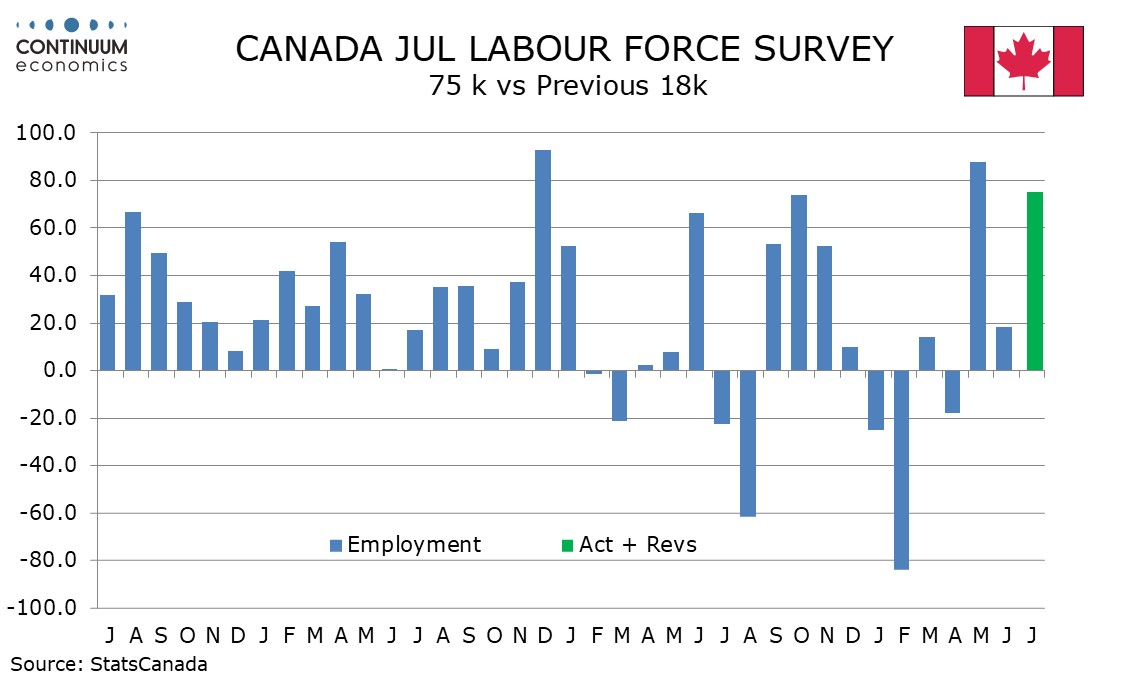
Three straight gains are not conclusive for the volatile series of Canadian employment. Four straight gains, three of them strong, were seen in the final months of 2025 before a string of weak months followed in early 2026.
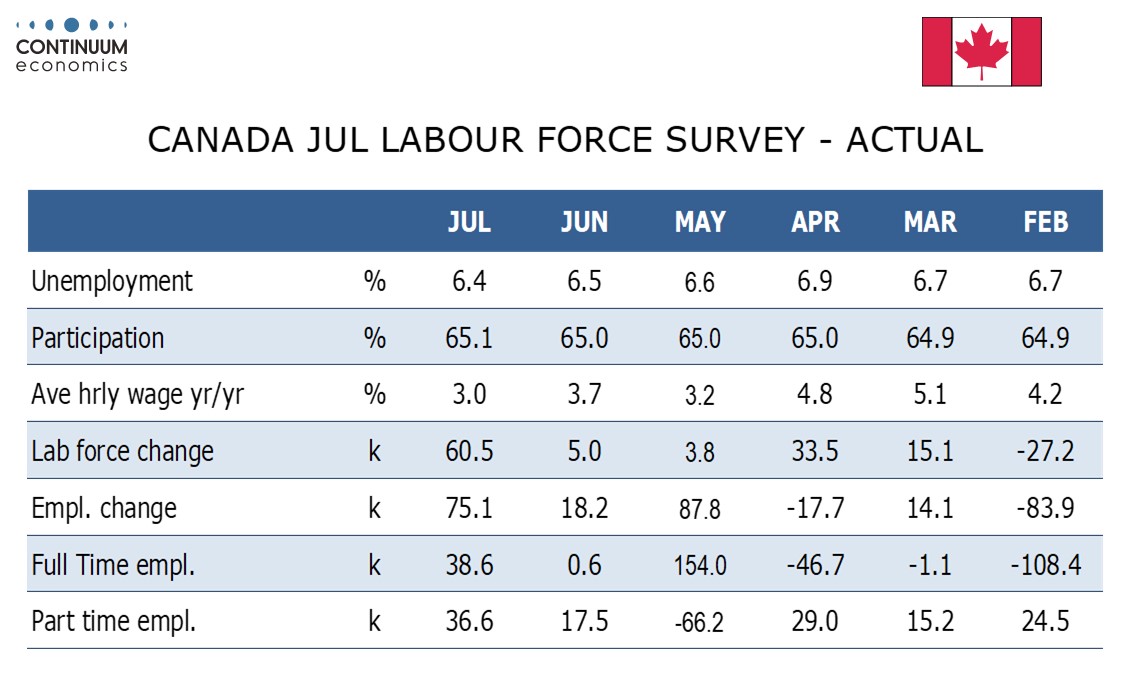 Still, the detail of the latest report is healthy, with both full time (by 38.6k) and part time (by 36.6k) seeing healthy job gains and the job gains coming despite a 27k fall in the public sector. Private employment rose by 57.9k but a 44.4k rise in self-employment is unusual. Manufacturing at 11.1k and construction at 15.7k rebounded from dips in June. Private services saw a second straight month of strength in wholesale and retail, up by 21.1k, but a correction lower in information, culture and recreation of 4.8k, where June data may have been lifted by the World Cup.
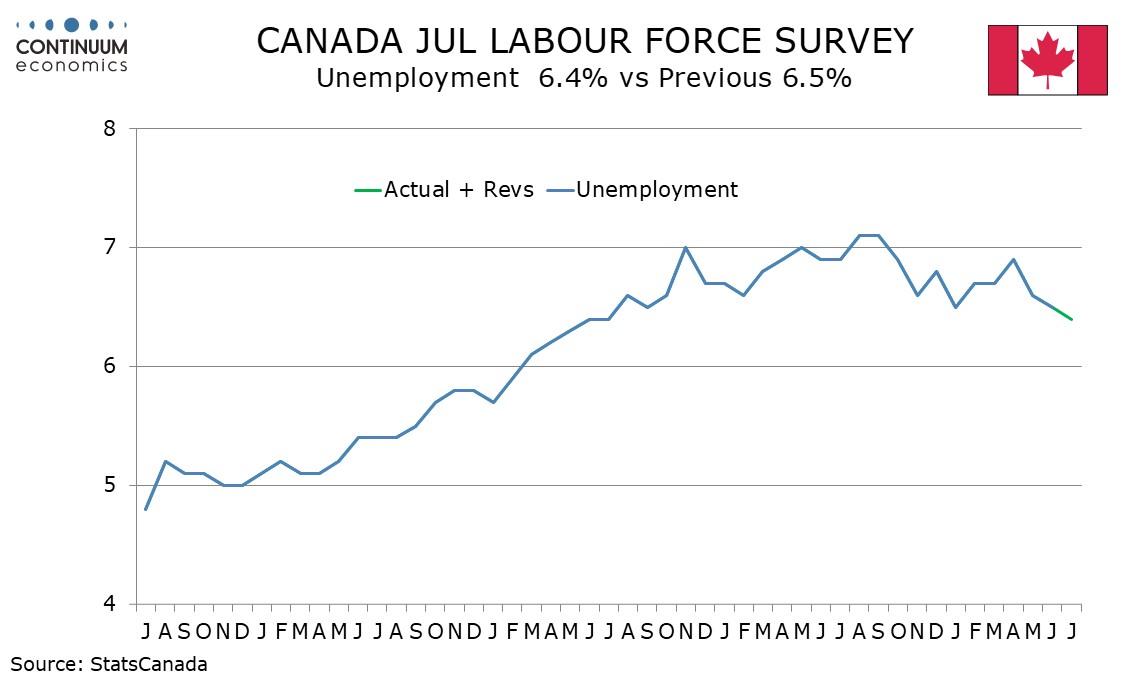
The unemployment rate of 6.4% is the lowest since July 2024 and continues a move off the peak of 7.1% seen in August and September of 2025. The Canadian economy does appear to be recovering from the tariff-led hit of 2025 but there is enough slack in the labor market (as illustrated by slowing wage growth) to mean no urgency for the BoC to tighten on labor market data alone, with fresh US tariffs a continuing risk. However, should ongoing Middle East risks start feeding into core inflation, the labor market is not posing a strong obstacle to tightening should inflation data require it.