Brazil: 25bps Cut and No Pause Signaled
• Brazil cut the SELIC by 25bps to 13.75%, with the statement acknowledging slowing economic momentum and leaving the door open to a November cut. With still high real policy rates, plus a well underpinned Brazilian Real (BRL), we look for two 25bps cut in Q4 to 13.25% end 2026. A pause could be seen in Q1 2027 as the BCB waits to see fiscal consolidation, before 25bps steps resume cutting to 11.50% by end 2027. This is still high nominal and real policy rates and can keep the BRL underpinned and we still forecast 4.75 for end 2027.
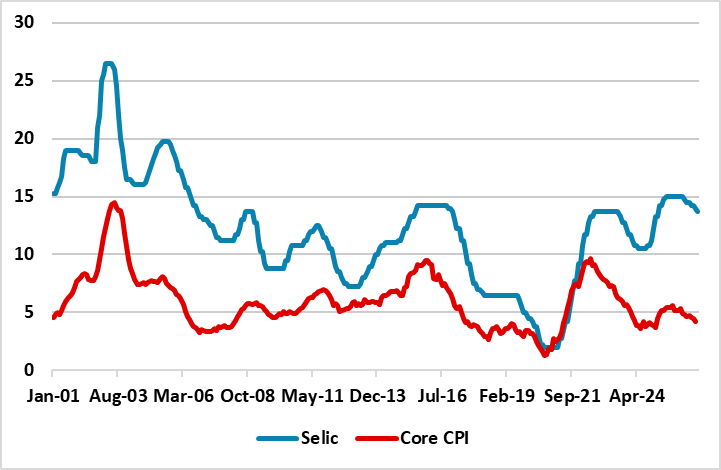
Figure 1: BCB Selic Rate and Core CPI Inflation Yr/Yr (%)
 Source: Datastream and Continuum Economics
The BCB cut by 25bps as widely expected. Inflation falling to 4.22% in August Yr/Yr, combined with recent signs of slowing economic momentum are the key drivers, alongside a still high real policy rate. The Q2 GDP showed a 0.4% contraction in household consumption, which is likely a concern. Though this reflects a correction from a strong Q1, it does signal a slowing growth. If the economic numbers continue to show a softening trend, then the BCB will likely cut again by 25bps to 13.5% at the November COPOM meeting. The BCB statement acknowledged the slowing trend in the economy and this leaves the door open to a cut. Though the BCB marginally increased 2026 and 2027 inflation, it left the policy relevant Q1 2028 at 3.2%. The idea that the BCB would pause after the September 17 cut is now being rethought in the market and the economy could mean a further cut to 13.25% at the December meeting, which is still our forecast. The BRL is not a restraint. Sentiment towards the BRL remains constructive. Brazil is a commodity safe haven for oil importers with disrupted supplies from the Middle East and grain buyers fearful of higher prices (Gulf fertilizer export freeze and a strong El Nino). Still high policy rates and bond yields provide ample real returns with inflation broadly controlled. The goldilocks macro story is finished with reasonable growth, which provides some scope to weather external storms.
2027 will likely see more BCB cuts to 11.50%, but then lower short and long-term yields help reduce government debt servicing and we would also see some fiscal consolidation. This could see a pause in Q1 2027, as the BCB waits to see the scale of fiscal consolidation. Thereafter easing will likely be at a pace of 25bps through the remaining quarters of 2027. An alternative scenario is that the economic slowdown is greater than expected, which causes more disinflation and increase confidence that inflation hits target. This could quicken the pace of easing in H2 and end up with a 10% policy rate end 2027 rather than our baseline of 11.50%.
Meanwhile, the October presidential election is fast approaching, with an outbreak of bitter infighting among some Supreme court members over their left or right wing leaning. This comes against a backdrop where opinion polls suggest that the 2nd round runoff of the presidential election is too close to call between President Lula and Flavio Bolsonaro – Bolsonaro has recovered over the last 2 months, after being hurt earlier in the year by the Banco Master scandal. So far the Brazilian Real (BRL) has not been hurt, as an election victory for Bolsonaro would be viewed as positive. Bolsonaro is seen as much more likely to enact sufficient fiscal consolidation to ensure government debt does not become unstable – though policy enactment also depends on control of Congress. Although, the positive drivers for the BRL are quite well appreciated, the real effective exchange rate has only just got to the 10yr average and most estimates of fair value on USDBRL are around 4.50. It is also worth remembering that the BRL can have large countertrend against the USD, which in 2006-08 was 30% during the last major USD downtrend. Current 10yr Brazil-U.S. bond yield spreads are currently higher than this period.
Post-election USDBRL will likely end 2026 at 4.95 if Lula wins, but 4.85 if Flavio Bolsonaro wins, as carry trades become the strong focus once again. Though we see further BCB easing in 2027, an 11.50% policy rate end 2027 would still be high in nominal and real terms. This can all keep the BRL underpinned and we now forecast 4.75 for end 2027. BCB has already tried some FX intervention, but this is unlikely to be effective unless accompanied by aggressive rate cuts.