Bank of England Hikes by 25bp - Another Hike in the Pipeline
The Bank lifted rates to 4% as expected and all members voted to hike even the arch doves. Of the 9 members, 8 members opted for 25bp while Mann wanted a 50bp increase. The Bank is touting a further hike even if Governor Bailey noted that it is not on a “pre-set path” though the longer the conflict “goes on the longer that pipeline pressures will build up”. Governor Bailey warned that a further rise may be warranted (ie the hint is that there will be just one further hike to 4.25%) while he also downplayed the number of hikes priced in by markets - currently to 4.75%. We now expect the Bank to hike by one final 25bp in February before cutting rates later next year.
Governor Bailey said that what the market is pricing in is a reflection of risk premia not expected rate hikes. There is some divergence of views in the committee with the two doves (Dhingra and Taylor) seeing this increase as a one-off insurance hike while Breeden and Ramsden seem to say they would wait for evidence of second round effects. The market is now debating whether the next hike will be in December or in February. We now expect the Bank to hike by one final 25bp in February to take rates to 4.25% before cutting rates later next year.
The Bank is currently balancing contrasting pressures, a near term increase in inflation, a resilient economy, concerns about second round effects, the length of the conflict and potential impact on pipeline pressures.
So far, the Bank says the increase in inflation has been energy related and there is little evidence of second round effects. But today’s updated views shows that inflation is now expected to be higher (as we set out in our preview).
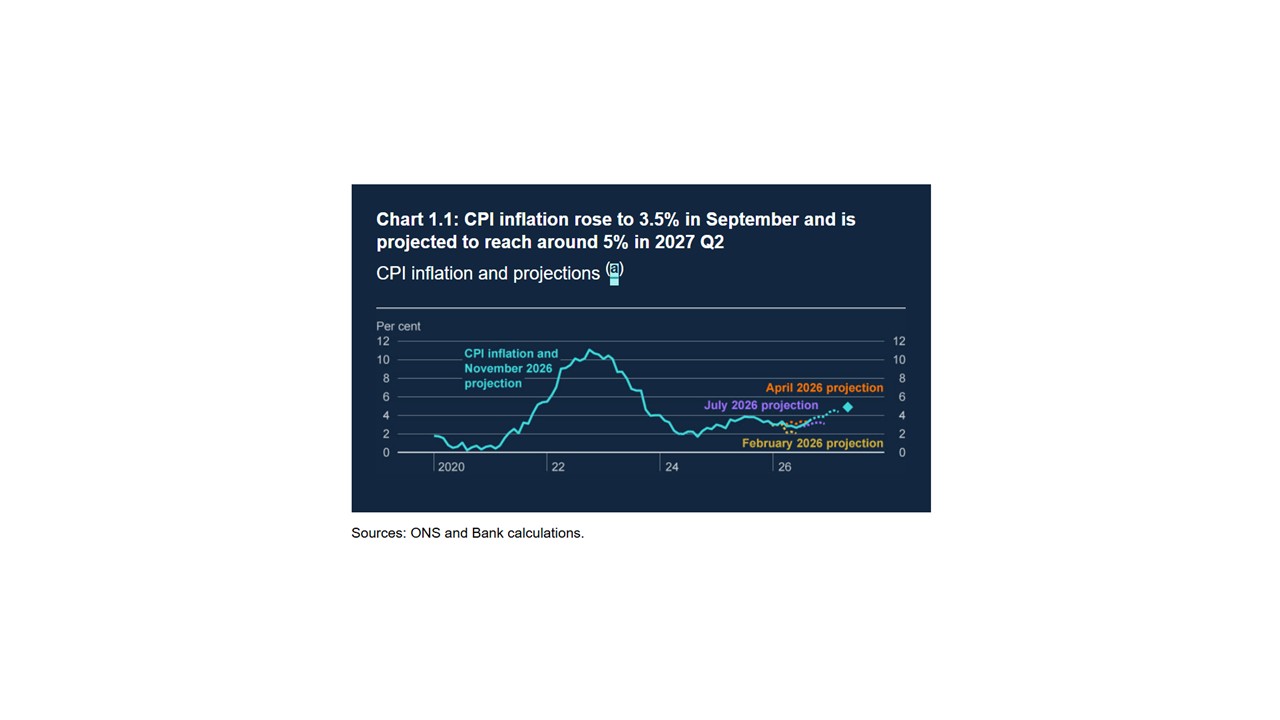
The latest near-term inflation projection by Bank staff, which was based on energy prices averaged over the 15 UK working days to 27 October, was for headline CPI inflation to reach around 4½% in 2027 Q1, around 1¼ percentage points higher than at the time of the July Report, and around 5% in 2027 Q2. Inflation will also be lifted by the near-term increase in energy price cap increase which will lift inflation above the Bank’s prior forecast. Inflation is then “projected to fall as the impact of rising energy prices on 12-month inflation rates fades, and still restrictive monetary policy bears down on inflation.”
As we noted in our BoE preview, while those second-round effects have not materialised there was some evidence in surveys such as the Bank’s own Decision Maker Panel (DMP) that showed there was increasing pressures on firms as the energy shock persists. In October, some 68% of firms said they expected to increase their prices over the next 12 months, up from 57% in September while 71% of companies anticipated lower profit margins as they struggle to fully absorb soaring fuel and utility costs. The longer the war goes on the harder it will become for firms to absorb higher costs. Wages remain stable. Private sector regular AWE growth was 3% in August and is projected to remain around that level over the remainder of 2026.
The bottom line: if energy prices continue to drop (already at USD90pb), we suspect the Bank will be more comfortable keeping rates unchanged in December and perhaps pushing the hike to February.
Figure 1: New BoE Inflation Forecast
Source: Bank of England/CE