The Fed's Balance Sheet: Revolution or Recalibration
· Fed chair Warsh has reopened the question of how the Federal Reserve implements monetary policy, not just the size of the balance sheet. The two go hand in hand.
· The realistic choice is not between today's balance sheet and a return to 2006, but among several ways of operating with fewer permanent reserves - each with a different price in volatility, complexity and reliance on central bank functions.
· Though the balance sheet taskforce is co-led by Karen Dynan, Raghuram Rajan, and Jeremy Stein, any change to monetary-policy implementation will be decided collectively by the FOMC and the wider board is more cautious. A pre-crisis replica is unlikely. The plausible centre of gravity is a leaner and more elastic floor - fewer permanent reserves, a shorter and eventually Treasury-only asset portfolio, somewhat more tolerance for overnight-rate variation maybe, and more routine use of facilities.
Fed’s Warsh has spent over a decade arguing the balance sheet should be smaller. He has said much less about the operating framework that would allow that without destabilising money markets. The task force he launched in June is intended to answer that.
The task force will examine the costs and benefits of the current ample-reserves regime, the composition of the Fed's assets, and alternative frameworks for conducting monetary policy. At his first semi-annual monetary-policy hearing, Warsh clarified that he did not think the Fed could simply return to 2006, but believed there were "several other sustainable equilibria" available. Any change would be gradual, publicly debated and communicated well in advance.
That leaves a preferred direction but no settled destination. Warsh wants interest rates restored as the primary normal-time policy instrument, a smaller Fed footprint and less allocation through mortgage-backed securities. Yet he remains prepared to use the balance sheet aggressively when markets stop clearing. What he has not specified is the resulting system, a choice that will shape money-market operations and financial institutions' management of liquidity and risk.
What the ‘more than ample reserves’ regime delivers
Under the current floor-style system, reserves are ample enough that ordinary fluctuations do not materially affect overnight rates. Policy is implemented mainly through interest on reserve balances, avoiding the need to fine-tune each day.
Figure 1: Fed balance sheet (assets)
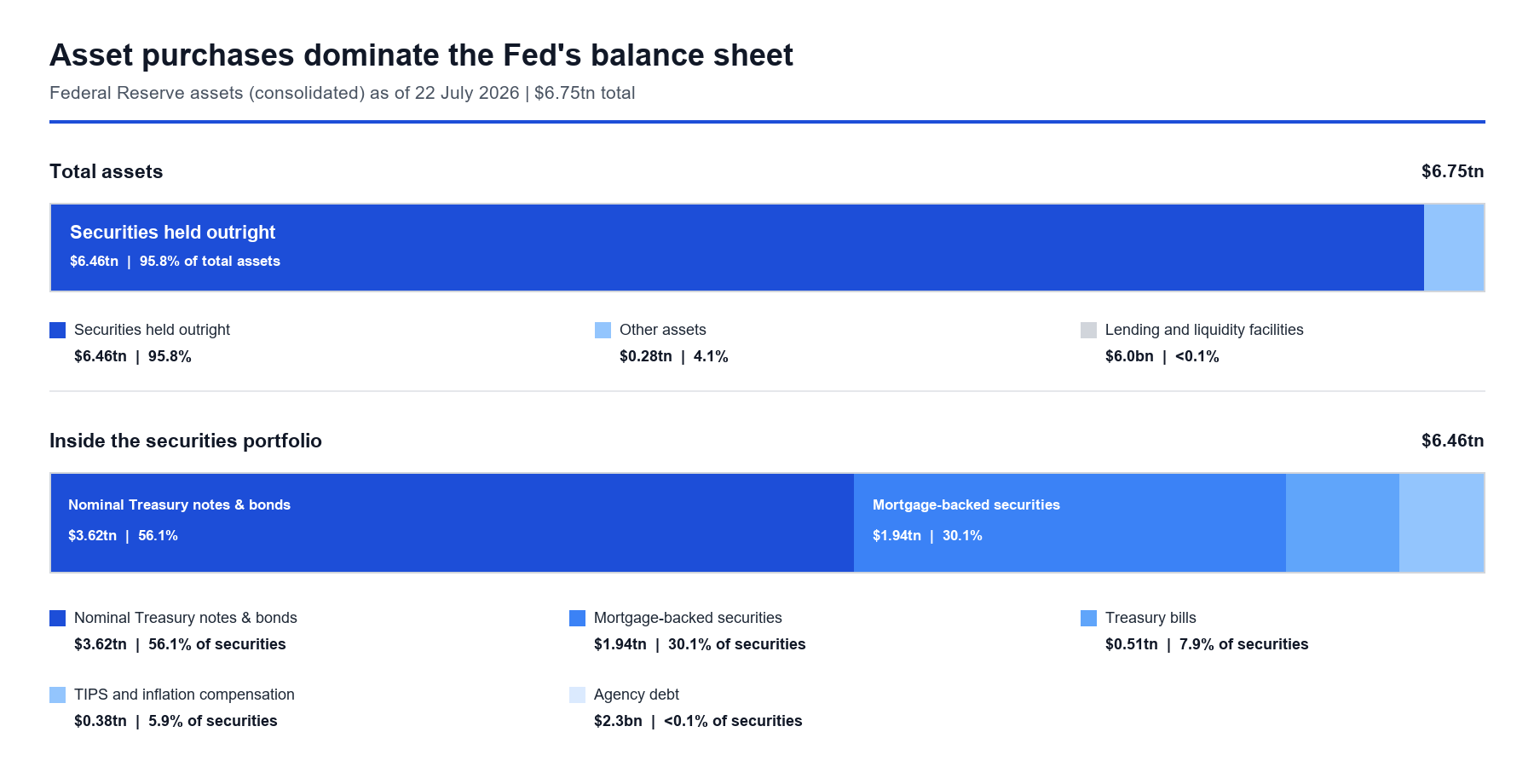
Source: Fed, H4.1
The upside is that it has, generally, delivered reliable rate control and operational simplicity. Fed’s Logan (here) puts the optimisation case neatly: a floor brings banks' marginal cost of holding the safest liquid asset close to the central bank's cost of supplying it (the ‘Friedman rule’). Reserves also provide immediate payment liquidity and absorb movements in currency in circulation, the Treasury General Account and settlement flows, without transmitting them directly into money-market rates. That logic underpinned the added quantitative-management purchases this year intended to rebuild the buffer. It also allows emergency lending or market support without sacrificing control of the policy rate.
But the insurance is not a free lunch. The Fed must hold a larger securities portfolio, as currently managed at least, and paying interest on huge reserve balances can be contentious. Abundance suppresses unsecured interbank activity and weakens the incentive to redistribute liquidity. Regulatory and supervisory practices (and market structures supporting trades such as the Treasury basis) can become organised around abundant reserves, making the measured demand for them partly self-reinforcing.
Aggregate abundance is not the same as liquidity everywhere: only banks can hold reserves, while dealer constraints can prevent that liquidity reaching repo borrowers. In September 2019, tax payments and Treasury settlement drained reserves just as dealers were financing unusually large Treasury inventories. Repo rates spiked despite reserve balances remaining far above pre-crisis levels. The Fed's subsequent analysis (here) emphasised how distribution, regulation and uncertainty mattered alongside the aggregate quantity.
The current regime has grown in tandem with QE, but the two can be independent. As Fed’s Waller has argued (here), a floor requires a sizeable asset portfolio but not long-duration bonds or MBS: the Fed could retain ample reserves while backing them increasingly with bills and short-dated Treasury securities (he suggests about half). His point is that reserves provide greater liquidity than bills at little to no marginal fiscal cost. Warsh's objection to credit allocation therefore does not by itself settle the choice of operating regime, even if in practice his reform objectives look to encompass both.
Four possible ‘equilibria’
1. A leaner ample-reserves floor
The least disruptive option is to retain the present architecture but reduce the reserve buffer, shifting the reserve-demand curve inward rather than abandoning the floor. A 2026 Federal Reserve staff paper (here) provides the most developed menu. Its proposals cut across these stylised categories - most would make the existing floor leaner, while a couple would move it towards the hybrid arrangements discussed below. They include recognising some discount-window capacity in liquidity regulation, reducing supervisory preferences for reserves over Treasury bills, making standing facilities more usable, offsetting predictable Treasury-account shocks and introducing a liquidity-saving mechanism to Fedwire. The paper also considers increasing the opportunity cost of reserves by allowing the effective federal funds rate to trade above the interest rate paid on them.
Figure 2: A Fed staff paper review of ‘menu’ of reduction items
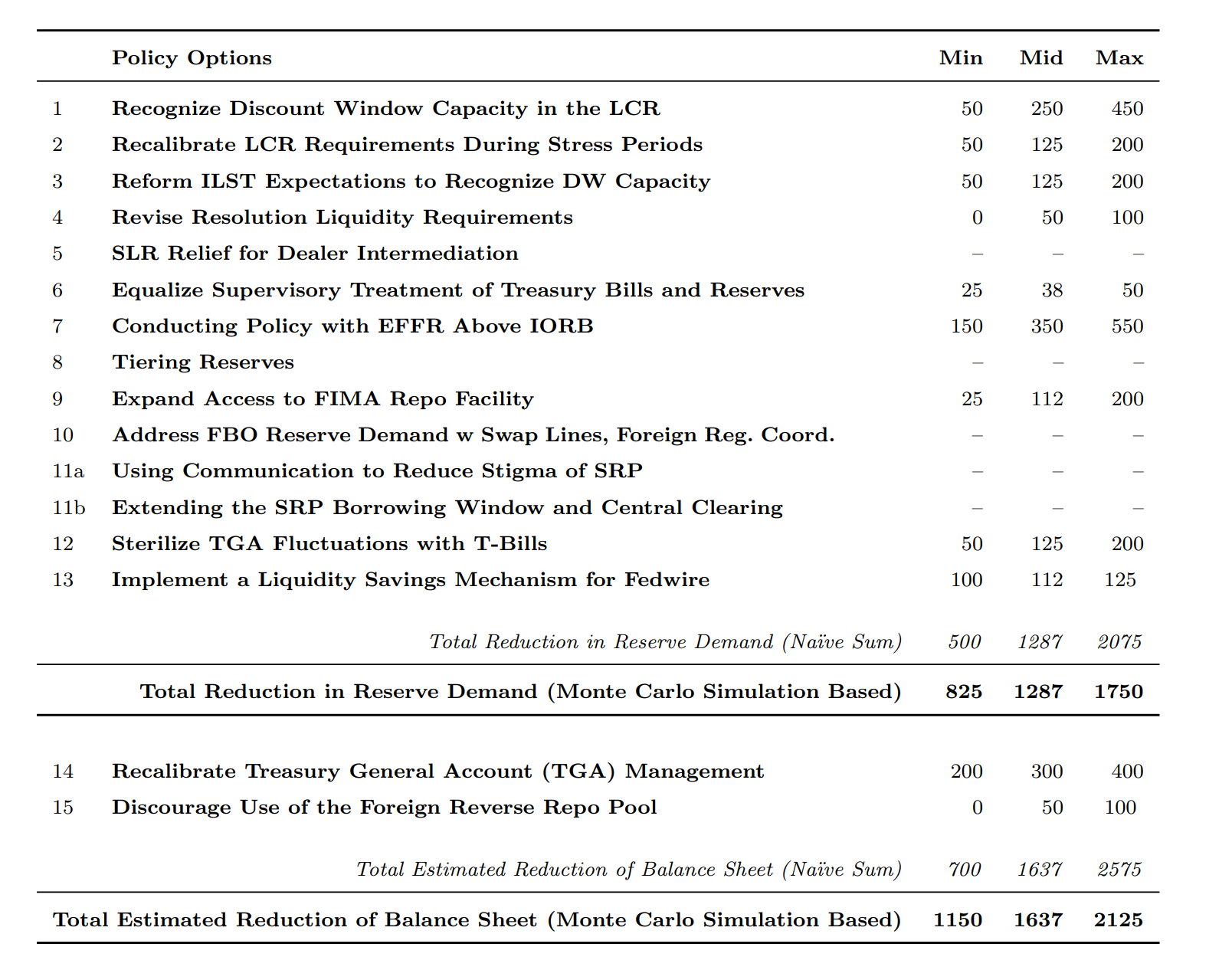
Source: Anderson, Alyssa G., Alessandro Barbarino, Anthony M. Diercks, and Stephen Miran (2026). “A User’s Guide to Reducing the Federal Reserve’s Balance Sheet,” Finance and Economics Discussion Series 2026-019.
The authors estimate these could collectively allow a USD1.2-2.1 trillion balance-sheet reduction without leaving the ample-reserves framework. They stress that this is a menu, not a policy recommendation, and that implementation could take several years. The trade-off is less protection against misjudging where reserve demand steepens, while some liquidity risk shifts from reserves held in advance to contingent Fed lending.
2. A repo-led elastic floor
A more substantial change would supply more reserves through regular collateralised lending rather than outright securities holdings. Banks would reveal their demand by borrowing against eligible collateral. Permanent reserves could fall, while repo operations expand and contract with demand.
This is already becoming common. The Bank of England (here) is moving towards a demand-led framework in which short- and longer-term repos supply much of the reserve stock; by February 2026, STR and ILTR lending supplied over ¼ reserve balances (here). The ECB's revised framework (here) similarly retains the deposit rate as its anchor while meeting marginal demand through weekly and three-month refinancing operations. It plans structural longer-term lending and a securities portfolio for the persistent reserve core. Both envisage repo borrowing as routine liquidity management, unlike the Fed's standing repo facility, which has principally operated as a backstop. In a crisis the ECB has used long term repos (LTRO’s) to expand the balance sheet, but then roll off the LTRO’s when the crisis has past (eg 2012 and 2020/1).
Figure 3: BoE’s growing repo lending
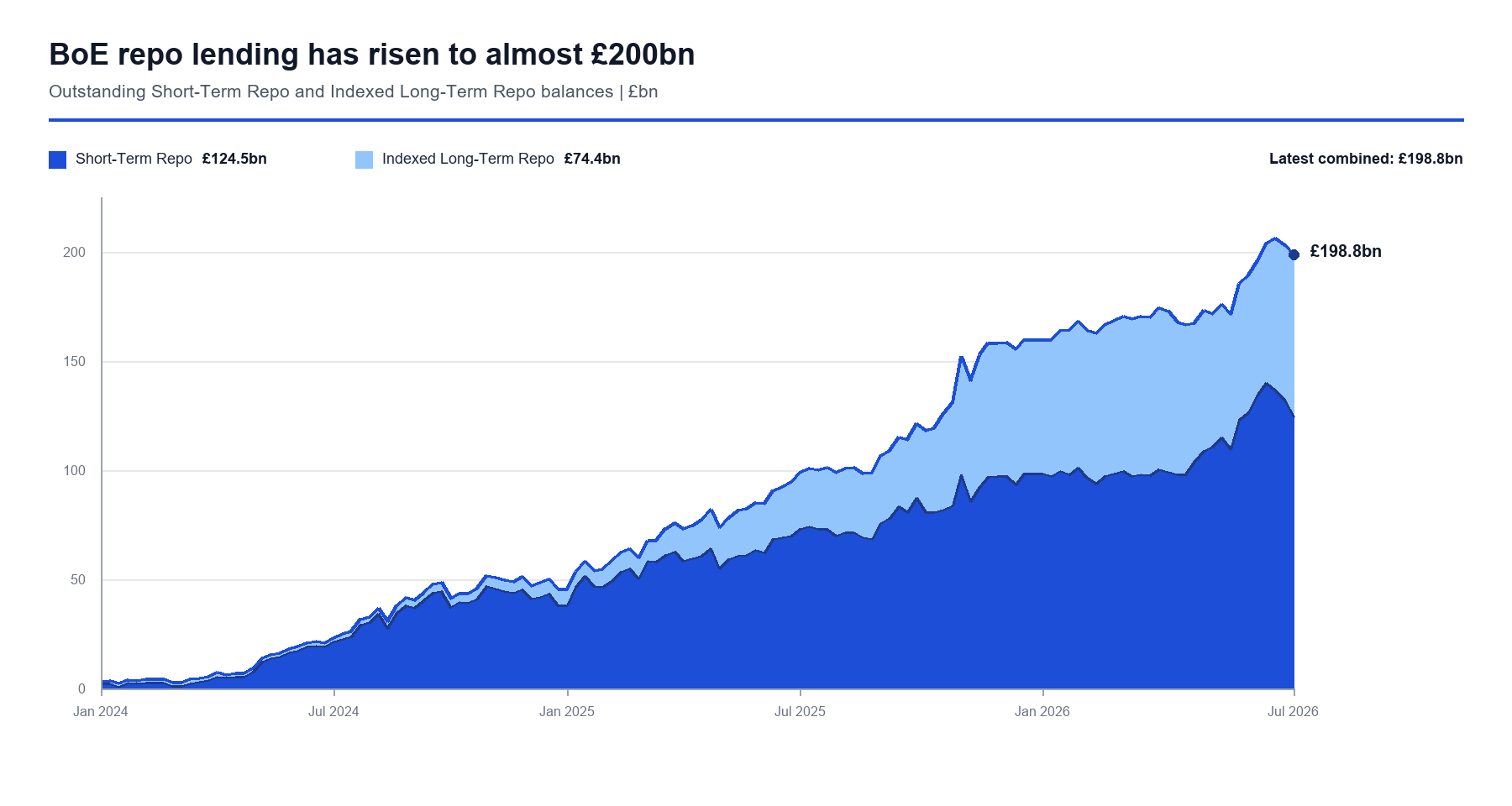
Source: BoE weekly reports
The model offers a smaller duration footprint and lets facilities expand automatically. Fed Barr's counterargument (here) is that ample reserves support payments and especially financial stability (also via the demand side factors). Additionally, replacing them with routine central-bank lending changes the composition of the Fed's balance sheet more clearly than its total 'footprint in financial markets' and makes it actively more interventionist. Success also requires pre-positioned collateral and manageable rollover terms.
Analysis by Barclays, via the FT, estimates the weighted-average maturity of the Bank of England's repo book at only about 36 days, suggesting that a durable system may still need longer-term operations or a structural securities portfolio.
3. A hybrid or tiered system
Between a floor and corridor lies a family of systems that retains substantial reserves but gives banks a positive incentive to trade them. One method is tiered remuneration (pay the policy rate up to a quota and a lower rate above it), another is to allow market rates to trade modestly above the reserve rate, making idle balances costly at the margin.
Norway has operated a quota system since 2011 (here), while other central banks combine moderately large reserve quantities with a small positive opportunity cost.
The appeal of using approaches such as these is greater interbank activity and price discovery without recreating full reserve scarcity. The cost is calibration. Quotas favour some business models over others, liquidity may migrate into other Fed facilities, and the relationship between the announced target, IORB and market rates becomes harder to explain. Tiering also needs to be able to mesh with supervisory/regulatory guidance.
A recent BIS taxonomy (here) argues that these two variables - reserve quantity and marginal opportunity cost - reveal more than the traditional floor/corridor titles. Systems with different names can produce similar incentives and market outcomes.
Figure 4: BIS taxonomy – reserves vs marginal opportunity cost axis
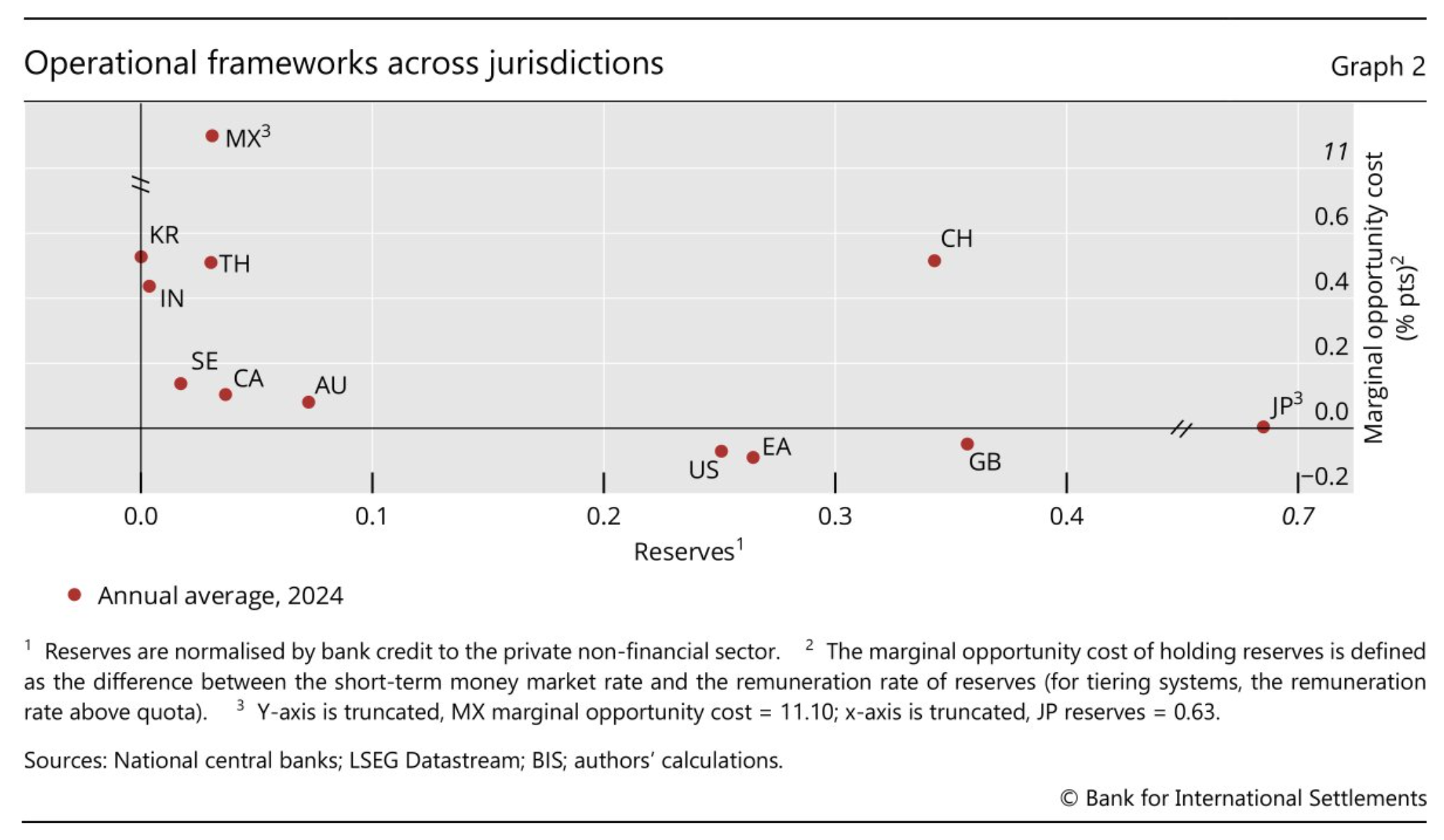
Source: BIS quarterly review, Sep25; Monetary policy operational frameworks - a new taxonomy; Paolo Cavallino, Mathias Drehmann, Richard Finlay and Julie Remache
4. A modern scarce-reserves corridor
The most radical option is to supply reserves on the downward-sloping part of the demand curve. In a move back to ‘old school’ money markets, the market rate would trade between a deposit floor and lending ceiling, with the NY Fed forecasting autonomous flows and conducting frequent operations to keep it near target. Reserve requirements or targets averaged over a maintenance period could make demand more predictable.
This restores a genuine market price for bank liquidity and permits the smallest structural balance sheet. But that smaller footprint is purchased by operating on the steepest and least predictable part of the reserve-demand curve, bringing more complex operations, noisier money-market signals and greater rate volatility. It can also complicate crisis management: reserve injections intended to stabilise markets may simultaneously change or muddy the operating regime and re-blur the distinction between liquidity support and the monetary-policy stance.
Nor could it just turn back the clock to 2006. Currency alone is now around USD2.4 trillion, the Treasury's cash balance is far larger and more volatile, and post-crisis payment and liquidity practices have permanently raised demand for central-bank money. Warsh's acknowledgement that the old system cannot simply be restored reflects that.
The binding constraint may not be reserves?
Even the lean-floor estimates may prove tricky because they focus on banks' demand for reserves. A June 2026 staff paper (here) identifies a separate constraint in repo-market capacity. QT places more Treasuries with dealers and leveraged investors, increasing their financing needs, while shrinking Fed liabilities reduces the liquid funding available to meet them. In the authors' model, money-market-fund cash supply binds before banks reach their minimum reserve demand, pushing repo rates higher and threatening overnight-rate control. The constraint is also state-dependent. Higher policy rates attract more money-fund cash into repo and permit a smaller Fed balance sheet.
Payments might impose another floor. A Brookings paper (here) argues that low reserve balances can delay payments, particularly at repo-active dealer banks. The proposed solutions (mainly Fedwire liquidity saving, also again exploring tiered remuneration, regulatory reform and smoothing predictable reserve shocks) again point towards redesigning demand along with removing supply.
Recalibration is more likely than revolution?
The task force can frame the options, but any change to monetary-policy implementation will be decided collectively by the FOMC.
A pre-crisis replica is unlikely. The plausible centre of gravity is a leaner and more elastic floor - fewer permanent reserves, a shorter and eventually Treasury-only asset portfolio, somewhat more tolerance for overnight-rate variation maybe and more routine use of facilities. Tiering or a modest positive opportunity cost could restore market activity without requiring full scarcity.
That would be a meaningful recalibration. A reduction on the scale contemplated by the Fed staff paper would change the quantity of safe assets held by banks, return more Treasuries to private markets and make bank liquidity management more active. But it would retain the essential post-crisis settlement and the Fed would remain able to expand its balance sheet rapidly in stress albeit perhaps not without some conceptual muddying and policy row back.
The larger question is therefore not whether the financial system needs liquidity, but where that liquidity should reside and when the Fed should supply it. Part of the standing reserve stock may be effectively replaced by a contingent balance-sheet commitment. The system may become more market-led from day to day, but the separation between interest-rate policy and balance-sheet policy may prove less complete when conditions deteriorate.
Indeed, if recent more fragile price action in US bonds were to extend, that would tend to reinforce the wider FOMC board being more cautious than Warsh when it comes to agreeing any notable adjustments near-term that could unsettle the market.