More Yuan Appreciation, but Controlled
• The Yuan has been appreciating driven by a large trade surplus; the ongoing trade truce with the U.S. after Trump May visit and official acceptance of Yuan gains. Even so, we feel that China’s authorities will pause appreciation at times via FX intervention to stop the move becoming too fast, but then allow appreciation to restart. A reopening of the Straits of Hormuz would make the authorities more willing to accept appreciation. We now see further Yuan appreciation to 6.65 by end 2026, though the authorities will be reluctant to see much more.
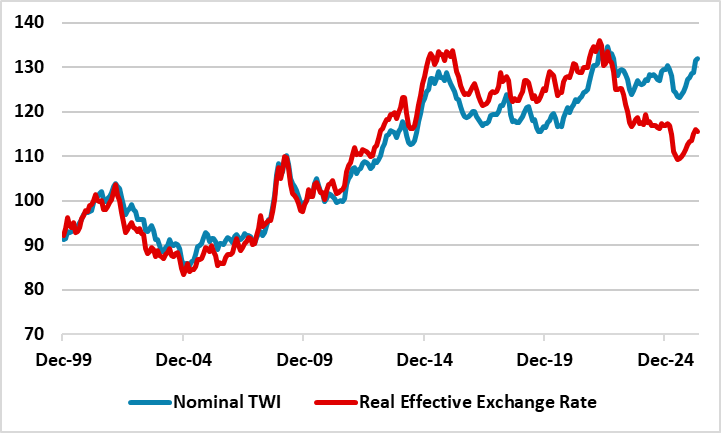
Figure 1: Yuan Nominal Trade Weight Exchange Rate and Real Effective Exchange Rate (Index)
Source: Datastream/Continuum Economics
China authorities are allowing a slow controlled appreciation of the Yuan. The Iran war has so far not hurt China economy, with coal/renewables playing a bigger part in electricity production. Additionally, monthly trade numbers also show that exports are still performing well, both due to Chinese companies keenness to export but also as the real value of the Yuan has fallen since 2021 with overseas inflation outstripping inflation in China (Figure 1). The current account surplus will likely be around 3.5% of GDP in 2026 and this will keep the Yuan firm. The May 2025 Xi-Trump summit has also reinforced the sense that tariffs threats are now under control and China/U.S. trade truce can hold. Nevertheless, China authorities need to see when the Straits of Hormuz is reopened, as a prolonged closure into Q4 could hurt global trade and China export prospects. We feel that the authorities will pause appreciation at times via FX intervention, but then allow appreciation to restart. A reopening of the Straits of Hormuz would make the authorities more willing to accept appreciation. This willingness to allow slow appreciation also appears to be linked by official desire to increase long-term usage of the Yuan. President Xi Jinping's 2024 speech also noted that the yuan should be widely used in global trade, investment, FX markets, and more importantly, have the status of a global reserve currency. We now see further Yuan appreciation to 6.65 by end 2026, though the authorities will be reluctant to see much more. Additionally, the 2yr spread between the U.S. and China also argues for slow further appreciation.
Figure 2: USD/CNY Exchange Rate 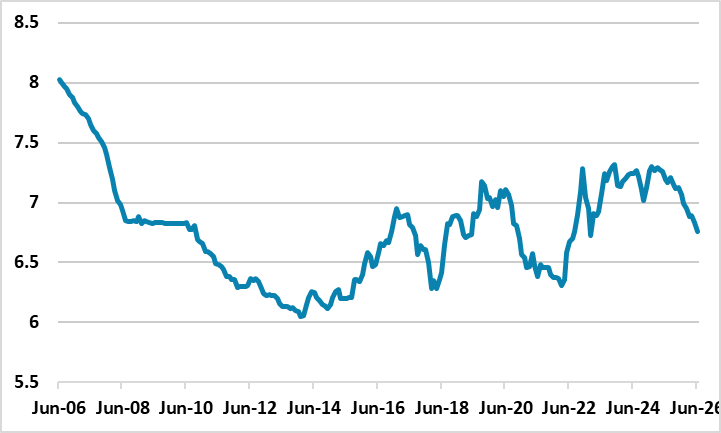
Source: Datastream/Continuum Economics
For end 2027 we forecast USDCNY at 6.50. China authorities did allow Yuan appreciation in 2014, 18 and 22 (Figure 2), but became sensitive below 6.25. Stepwise this probably translate into a restraint around 6.50 in 2027. Additionally, China prospective returns for bonds and equities are unattractive for active global investors, even if global benchmarks require passive funds to increase weighting in China. FDI data also shows that inflows have slowed, as the private sector business environment is less positive than the go-go years from 1990-2019. FDI inflows will likely be narrowly focused on AI and Green energy. However, the current account surplus will remain large and this will keep the Yuan firm. We see 6.50 by end 2027.