Despite tariffs, US trade deficits increasing and Canadian trade surpluses increasing
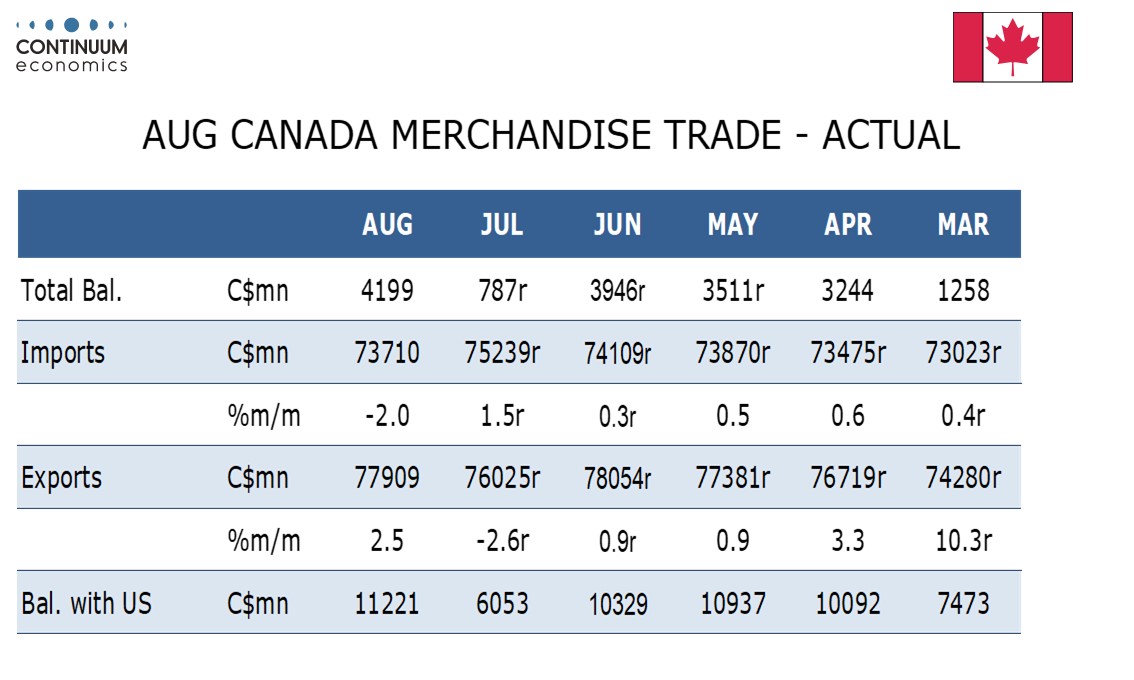
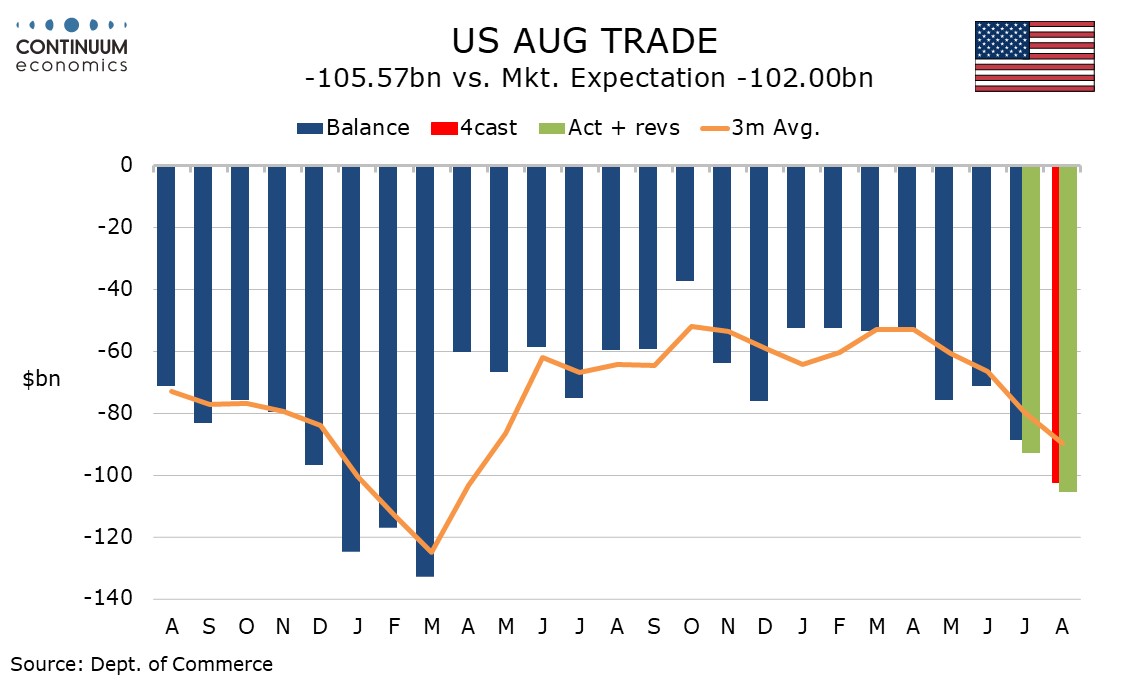
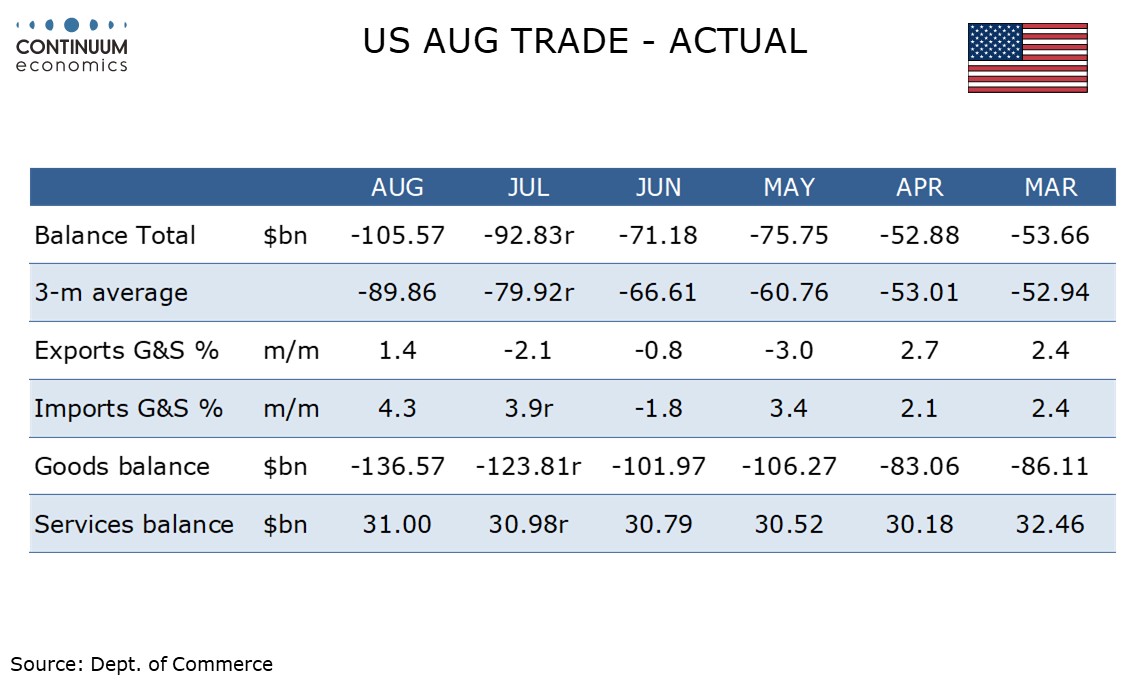
A wider than expected August US trade deficit of $105.6bn from $92.8bn contrasts with a wider than expected August Canadian trade surplus of C$4.2bn versus C$0.79bn in July. The US deficit is the largest since the pre-tariff record of $133.0bn in March 2025. Canada’s August surplus is the widest since May 2022 though only marginally larger than June’s.
July’s US trade deficit was revised significantly higher to $92.8bn from $88.6bn. July exports were unrevised with a 2.1% decline which was followed by a 1.4% increase in August. July imports were however revised up to a 3.9% increase from 2.8% with August’s rise stronger still at 4.3%. Trend in exports still looks quite subdued but imports have recently accelerated sharply, and that will be a restraint on what will be an otherwise strong Q3 GDP breakdown.
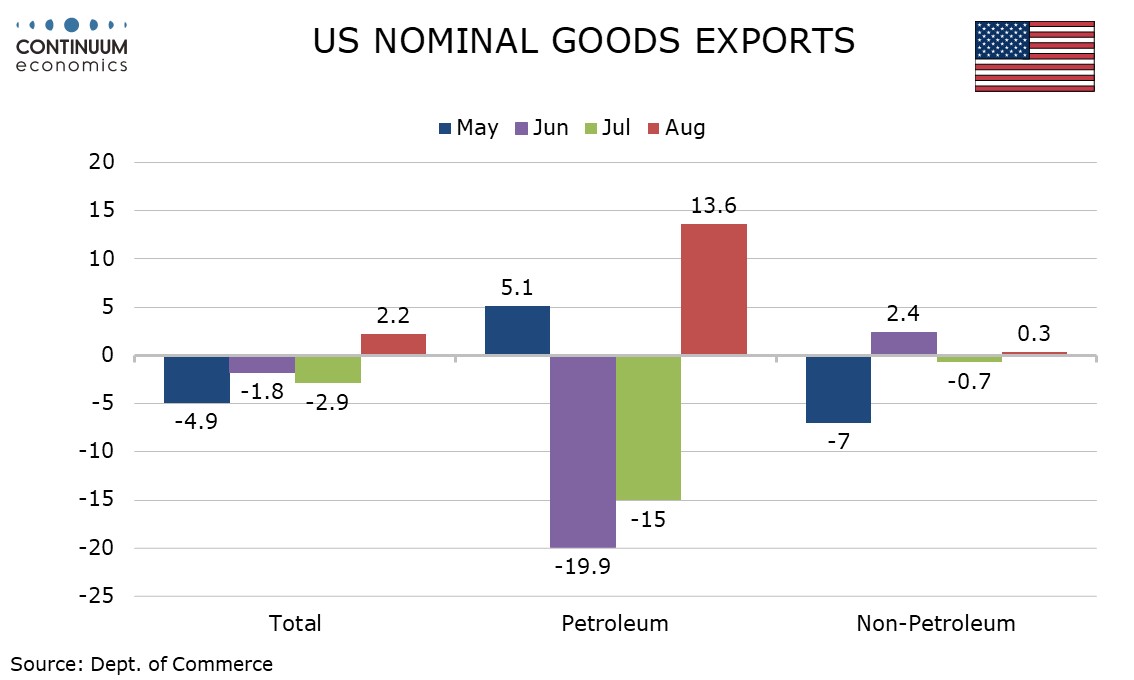
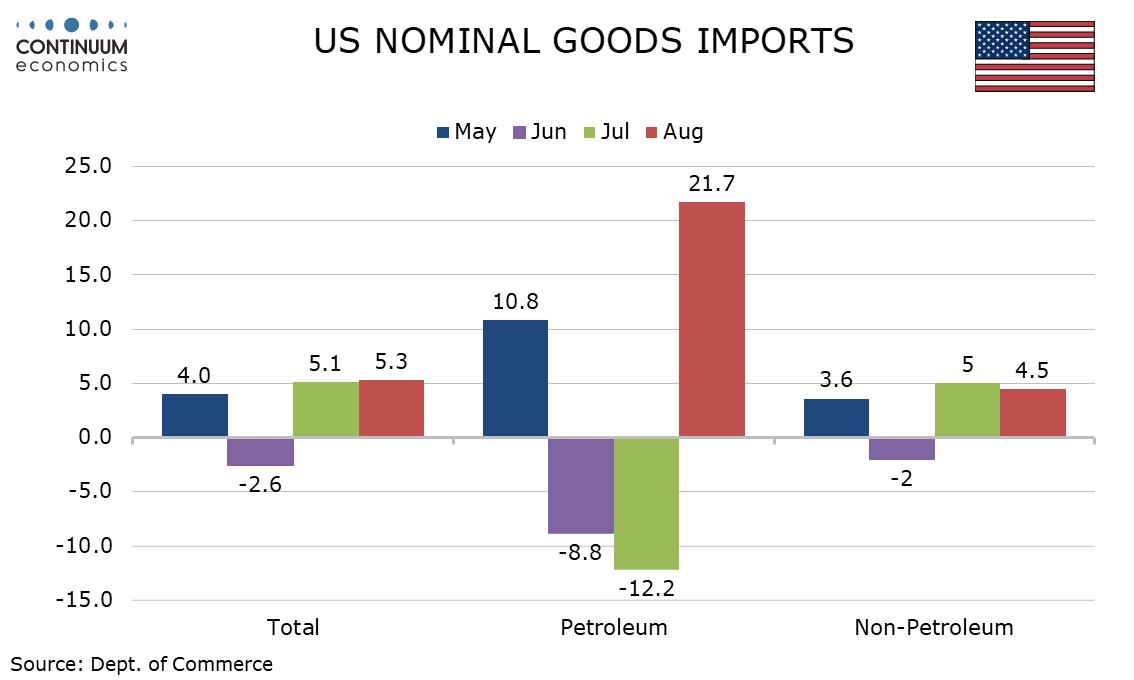
In August, goods exports rose by 2.2% versus 1.9% in the advance report while goods imports rose by 5.3% versus 5.5% in the advance report. Services saw both exports and imports almost unchanged, with the services surplus also stable at $31.0bn.
Goods exports rose by $4.4bn on the month. Nonmonetary gold, a volatile component, rose by $2.3bn while there were gains of $2.0bn in crude oil and $1.2bn in fuel oil. Semiconductors, computers and computer accessories each rose by between $0.9bn and $1.0bn. Most other components of exports were subdued with pharmaceutical preparations, another volatile component, down by $2.4bn.
Goods imports surged by $17.2bn. Crude oil at 3.3bn and nonmonetary gold at $3.1bn saw strong gains here too, the pick-up in oil coming as more oil is exported from the Middle East. Semiconductors rose by $2.8bn, but unlike exports imports were broadly strong outside a few particularly large increases. Pharmaceutical preparations fell for imports too, by $1.2bn.
Data by country shows a deficit with China of $18.4bn, the widest since February 2025. The deficit with Canada also bounced after a July narrowing and that is consistent with Canadian data. Canada’s trade balance is now showing a string of surpluses starting in March, contrasting a string of deficits in the year before that as US tariffs were introduced.
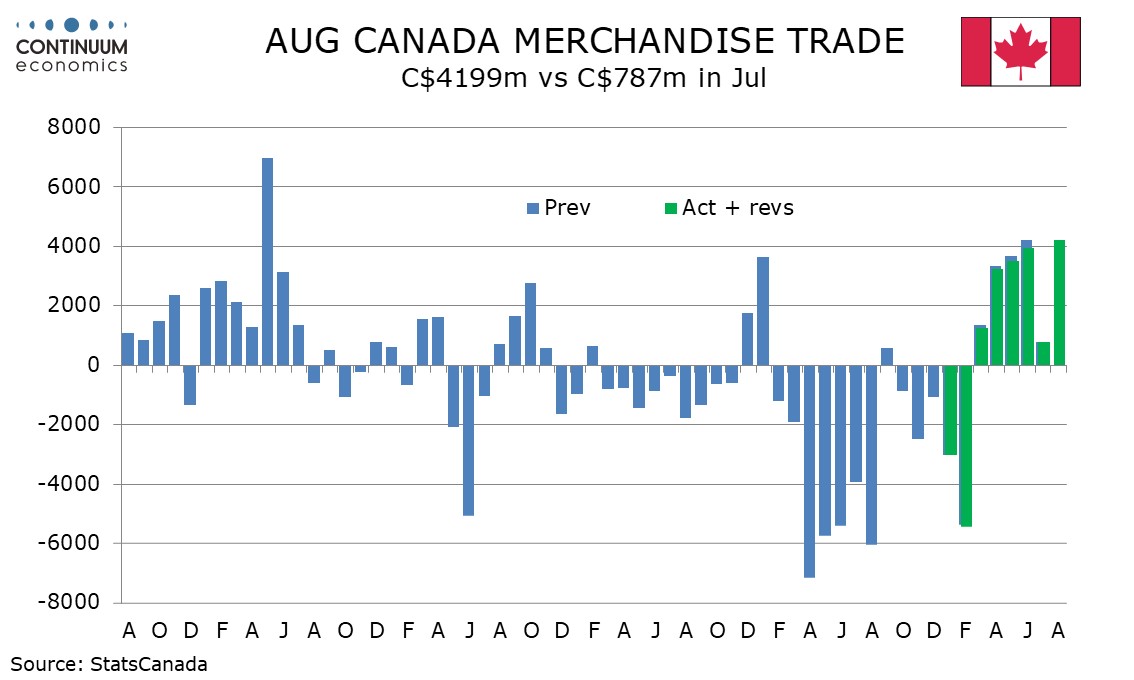
Canada’s monthly data shows exports up by 2.5% while imports fell by 2.0%. In real terms exports rose by 2.5% while imports fell by 1.1%. The exports gain was led by industrial machinery and electronic and electrical equipment. The imports detail showed a particularly sharp decline in autos.