FX Daily Strategy: Asia, Sep 2
RBNZ To Hike by 25bps
Bank of Canada Risks on both sides
U.S. August ADP Another subdued month
The RBBNZ is expected to hike by 25bps in their September meeting. It would be a hawkish surprise if they decided to do a 50bps instead. The odds of them not hiking is slightly lower than doubling up. As they are already expecting an overshoot, a 25bps remain our central forecast as there is little inflationary surprise in the past quarter.
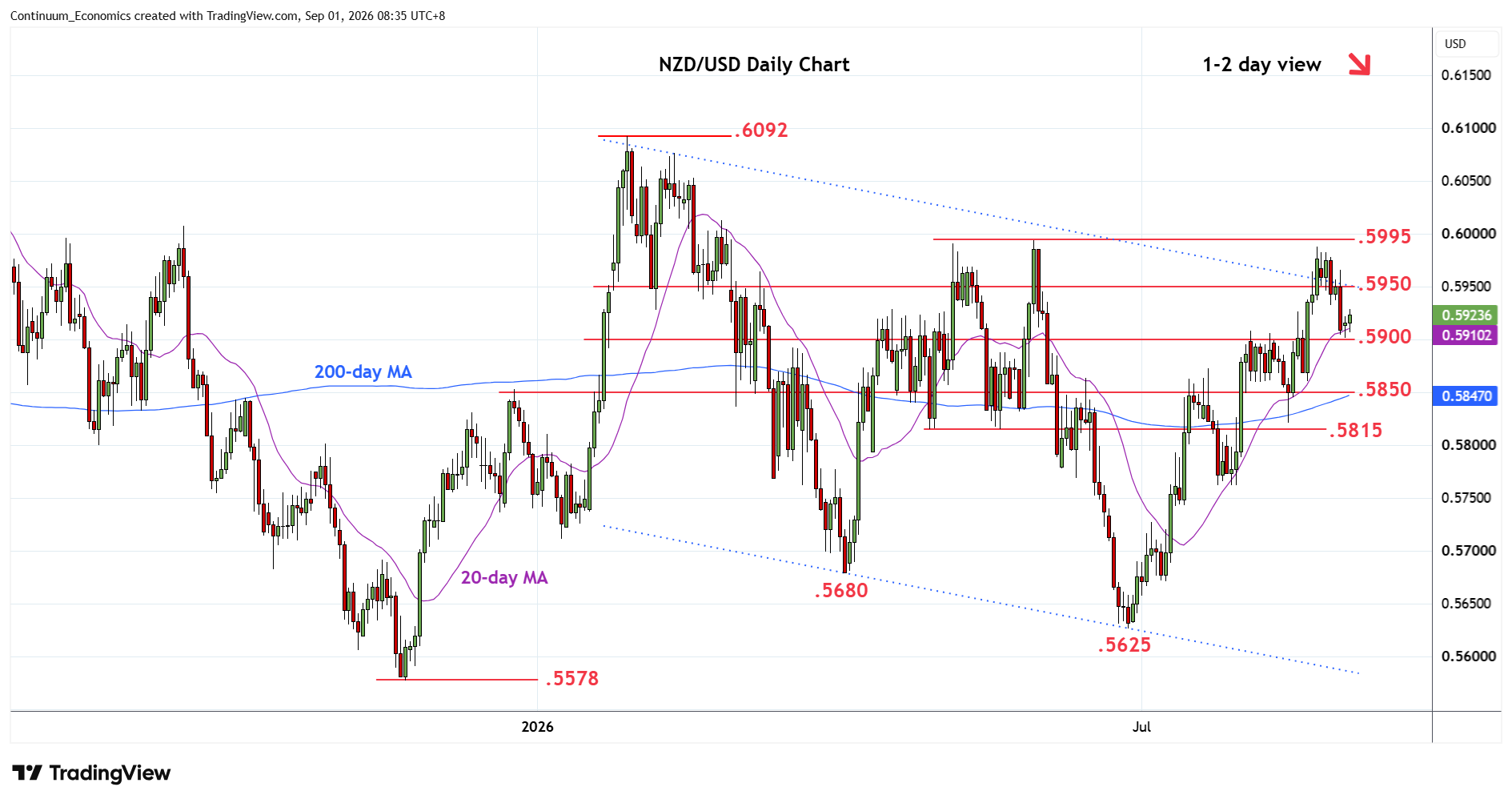
On the chart, NZD/USD turned up from test of the .5900 support as prices consolidate losses from the .5988 high. Negative daily and weekly studies suggest this giving way to deeper pullback later to retrace strong gains from the .5625 June current year low towards support at the .5850 congestion and 38.2% Fibonacci level. Correctiion from the .5988 high is expected to give way to renewed buying interest later with resistance starting at the .5950 congestion. Regaining this will expose the .5988 high to retest and see room for extension to the May high at .5995 and the .6000 figure.
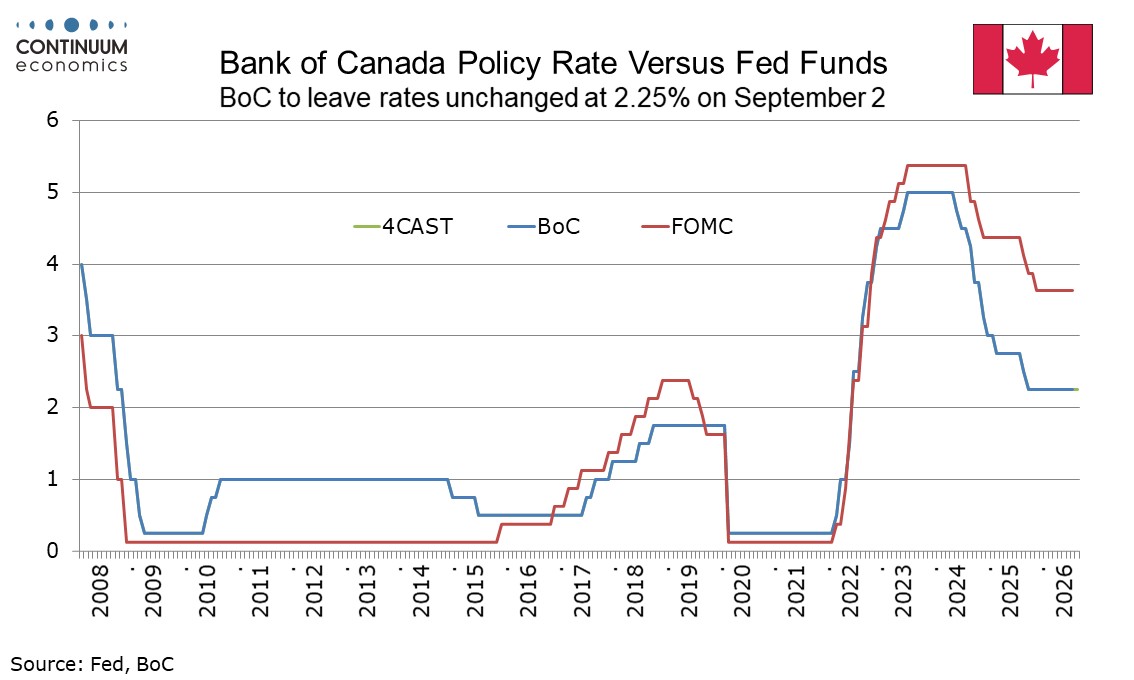
The Bank of Canada meets on September 2 and looks set to leave rates unchanged at 2.25%. While the meeting will come at a time of heightened trade tensions with the United States, we do not expect any hints that near term easing will be considered. Middle East risk and Canadian trade retaliation pose inflationary risks. We expect the next move will be a tightening, but not until Q2 2027.
The Bank of Canada has now left rates unchanged since its last easing in October 2025. Earlier in this year, the Bank of Canada pointed to the potential for tightening if elevated oil prices fed into core inflation, and easing if increased US tariffs undermined the economy. The July 15 meeting however, did not give any explicit hints of rate moves in either direction, though Governor Tiff Macklem did note that the greatest risks remained from the Middle East conflict and the trade relationship with the US. At that time Middle East risk appeared to be easing but that is no longer the case. Since that meeting July CPI also came in slightly stronger than expected. The BoC’s core Median and Trim CPI rates remain close to the 2.0% target, but ex food and energy CPI has seen three straight seasonally adjusted gains of 0.3%, hinting that core inflation is fining a base near 2.0% as the economy regains momentum.
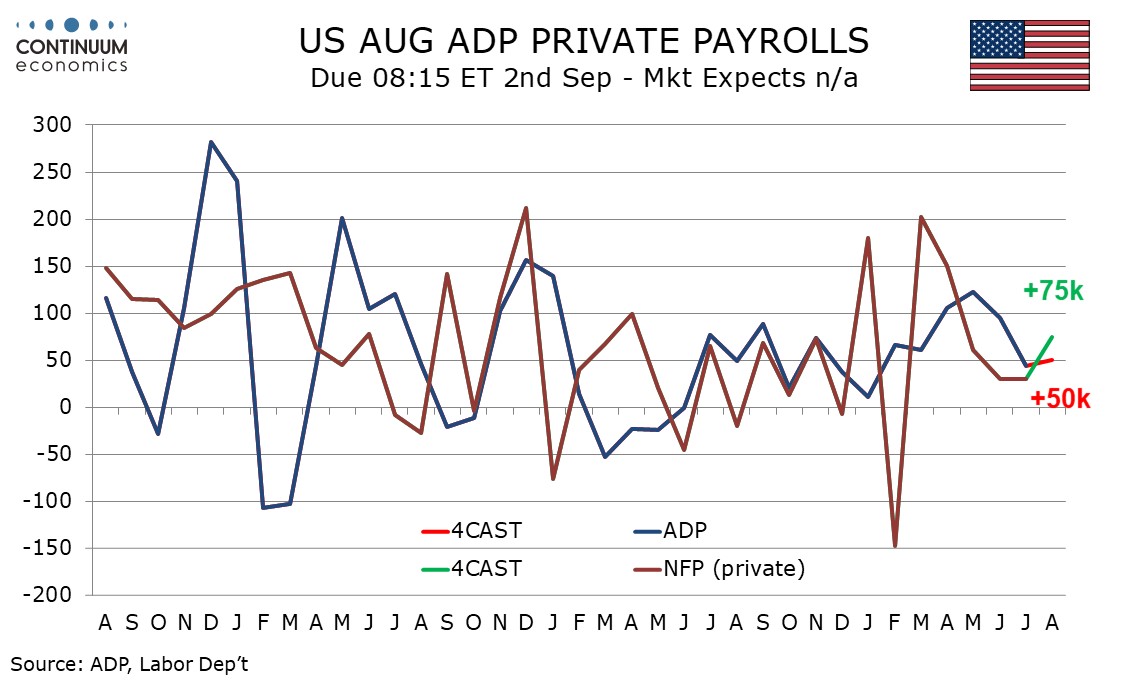
We expect a 50k increase in August’s ADP estimate for private sector employment, which is below our forecast for August’s private sector non-farm payroll of 75k (we also expect overall payrolls to rise by 75k). This would be the first ADP underperformance of payrolls in four months. Weekly data from ADP for the week to August 8, the week before the monthly survey, shows a 4-week average of 11.75k, which implies a monthly pace of close to 50k. A rise of 50k would be similar to July’s ADP report, which increased by 44k, outperforming a second straight increase of 30k in private sector non-farm payrolls.
Private sector payrolls underperformed ADP data in June and July largely because of payrolls showing declines of over 40k in leisure and hospitality, which we expect to correct higher in August’s non-farm payroll. Leisure and hospitality may improve on a decline of 11k seen in July’s ADP report, but has less rebound potential than in the payroll. July’s ADP gain was led by a rise of 36k in education and health. August may see some slowing here, but we still expect it to be the strongest sector.