FX Weekly Strategy: Asia, Sep 14-18
A week of 2 key central bank meetings..
We expect a 25bp Fed hike but perhaps a "dovish hike". Could temper dollar given a lot priced in further out
BoJ also seen going 25bp. A heavy USD/JPY needs validation on shift to quarterly pace however to extend - else to re-test persistence of supply
CHF still remains back of the central bank pack and the most consistent short
0.86/20 remains important s/t resistance on EUR/GBP
An important week ahead dominated by two major central bank meetings that are pivotal, not only for the latest decisions, but also for shaping market expectations on the Fed and BoJ paths and reaction functions going forward.

Our call has been for a FOMC 25bp rate rise this week and after the firm CPI data on Friday market expectations have firmed up now to around 85% from 50-50 a week ago. The decision might not be fully unanimous though (some other CPI measures have moderated) and comments may reflect that, perhaps even the votes. This meeting also sees the SEP projections moreover and they may be a tempering influence given how much tightening the market currently has priced in – the majority central projections are unlikely to validate this tightening path, instead erring towards ‘one and done’ and potential trimming further down the road. Views are likely to remain quite mixed around this median and Warsh himself is likely to continue to refrain from offering an outlook. The devil will be in the detail then and also very much dependent on the market mood as to whether it chooses to take the Fed at its word or stick to its own guns.

The BoJ is in some ways a similar scenario though with the market arguably much more sensitive to the signalling – a 25bp hike is also at least 75% priced in, but in terms of reaction the market really does need to be thrown a bone to validate the shift in tightening cadence that has been largely factored in. The BoJ may not be explicit about a change in pace to quarterly from semi-annual on the hike path, but it will need to at least give some indication that it is shifting gears if the net result is not to fall flat.

In terms of market structure, USD/JPY remains heavy long-term, and indeed very quick to ‘sell the fact’ out of the US CPI data after the very limited oversold bounce prior. Levels down at 152~ still look like being tested at some point next. If the BoJ is not sufficiently hawkish though and gives the impression that the Sep hike is just one month early rather than extra, then resistance at 155-156 could see a further test. Current action is more two-way out of the recent setback but at the moment the impression remains that some medium-term positions may be looking to lighten into bounces, while export supply may also have shifted lower.
EUR/USD has been the battle of the hawks of late, after last week saw both Fed and ECB expectations marked higher, leaving the pair still caught at the 1.16 anchor. If the Fed is deemed a dovish hike then 1.1650 is key on the close range, above which stretches back to 1.17. Recent range feints have caught the market repeatedly offside of late, attempting to follow the intraday noise.

One trend that does continue to prevail is long EUR/CHF, as the CHF increasingly stands out as the low inflation, non-hiking, zero rates, counter. 0.9500 is the next level up., then 0.9630-60 further up.

On sterling, the 0.86-8620 remains the key range resistance area. While that holds, the market is still tending to fade purely from a chart perspective. The upside on the GDP print last week helped keep that cap and range selling in place. A break and hold of the cap however would flip the market long. Bigger picture, with the BoE still seen sticking by its majority hold on policy through the end of the year, central bank divergence is still thematically playing to some underperformance. UK inflation data this week will be watched closely – the headline is expected to rise and remains very elevated but key will be whether the details continue to support the MPC majority’s benign underlying interpretation.
Data and events for the week ahead
USA
US focus will be on Wednesday’s FOMC meeting. We expect a 25bps tightening to a 3.75-4.0% Fed Funds target range though the decision may see a few dissents. We expect the dots will show no further tightening this year and one 25bps easing in each of 2027, 2028 and 2029, moving the rate back to a neutral 3.0-3.25%, though the dots may see a hawkish skew, particularly in the near term.

The week’s most significant data release also comes on Wednesday with August retail sales, where we expect a 1.0% rise after a weak July, 0.5% ex auto, and 0.4% ex auto and gasoline. Wednesday also sees July business inventories, where existing data suggests a strong 0.8% increase, and September’s NAHB homebuilders’ survey.
September manufacturing surveys are due from the Empire State on Tuesday and the Philly Fed on Thursday. Thursday’s initial claims release will cover the survey week for September’s non-farm payroll. Also on Thursday we expect August housing starts to rise by 8.2% to 1.34m while permits fall by 1.6% to 1.41m. August pending home sales follow. On Friday we expect August industrial production to rise by 0.3%, 0.4% for manufacturing. August’s leading indicator is also due.
CANADA
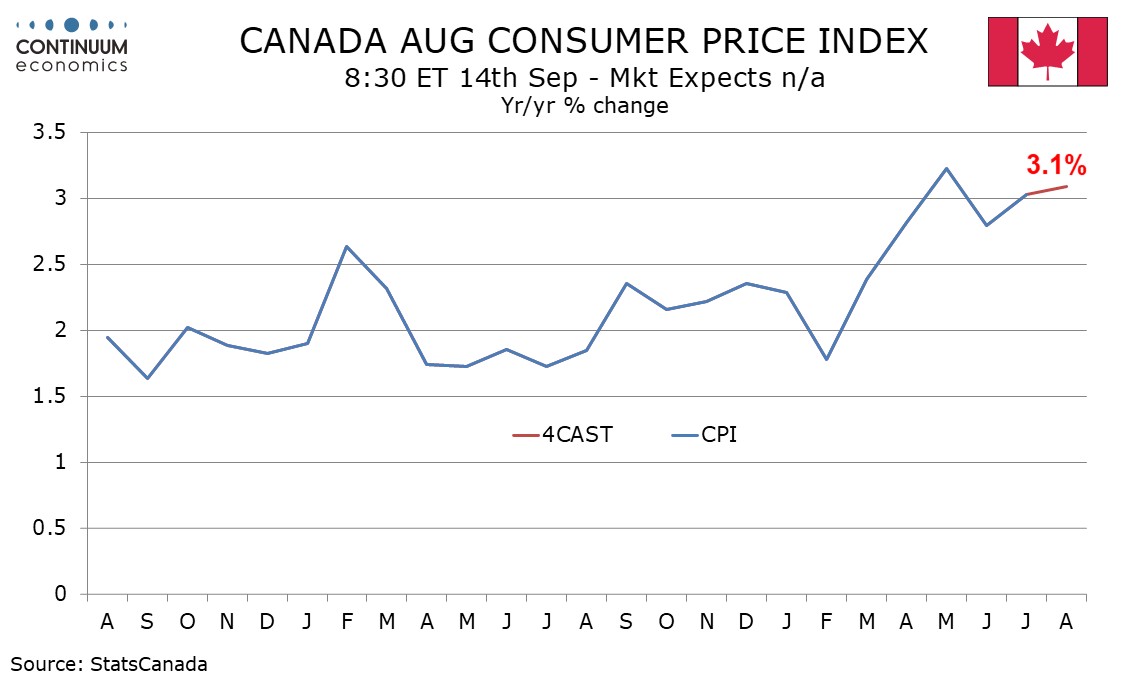
Canada’s key release is August CPI on Monday. We expect an increase to 3.1% yr/yr from 3.0% overall but stable Bank of Canada core rates. Monday also sees July manufacturing shipments, for which the preliminary estimate was for a 0.2% decline, while Tuesday sees July wholesale sales, for which the preliminary estimate was for a decline of 0.6%. August existing home sales are due on Tuesday, while Wednesday sees July building permits and August housing starts. August’s IPPI and RMPI are due on Thursday.
UK
Next week sees the release of CPI data for August, labour market statistics including average earnings for July and the BoE monetary policy decision on Thursday. On inflation, the annual headline rate increased to 2.9% in July with a further rise to 3.1% expected in August while core is forecast to remain unchanged at 2.6%. The Bank is expected to hold rates at 3.75% with money markets then expecting policymakers to implement at least two hikes by next March. Our view remains that the Bank is more likely to cut rates twice next year (two moves of 25bps each) given little evidence of second round effects on inflation and a softer growth outlook. Appearing at the Treasury Select Committee this week the BoE governor Bailey said that “When you look at the market curve, and when you break the market curve down as far as we can do ... they've got essentially a risk premium in there" and that he wanted “to dispel the idea that we've really got a secret plan, we know where we're going to go to and it's unconditional"
Eurozone
Little data of importance next week other than the final print of August CPI. The flash estimate have already shown an increase in the annual headline rate to 3.3% and a moderation in core to 2.4%.
JP
National CPI on early Friday and the subsequent BoJ interest rate decision are the most critical events this week. The August CPI should remain capped and market focus will turn to the BoJ interest rate decision. Widely expected a 25bps, we believe market participants will be disappointed by the lack of commitment/timing of the next rate hike. There is a lot of fronts running baked in the USD/JPY pair, which could see a strong rally. Apart from that, trade balance will be on Wednesday.
AU
Clear calendar for Australia next week, only some tier two throughout the week. There are further RBA speakers this week with assistant governor Hunter on Monday and governor Bullock among those giving parliamentary testimony on Friday
NZ
Kickstarting with Business PSI, Q2 GDP on early Thursday will be critical. It should remain in expansion. Followed by trade balance on Friday.