FX Daily Strategy: Asia, Jul 30
FOMC, US Iran action, and earnings provide the backdrop
Focus then turns to the BoE (seen unchanged), and EZ GDP and CPI data
CHF vs JPY becoming an interesting topic
Reaction the FOMC will of course dominate the backdrop to the day ahead, with the market also watching for US retaliatory strikes after Trump’s comments, and ongoing earnings.
Thursday also sees the focus turn to the BoE, while the market will also be looking ahead to the BoJ conclusion on Friday (you sometimes get some local leaks).
In terms of the BoE, while the Bank is likely to keep a hawkish bias, they are unlikely to signal a September hike. Recent data has not really changed the overall picture. While Bailey recently noted the unstable backdrop (in the Straits of Hormuz and for energy prices), he also noted that economic data pointed to limited impact on UK inflation and this argues against signalling a September hike. We remain of the view that a soft economy will stop the BOE from hiking and that policy rates will be cut in 2027.
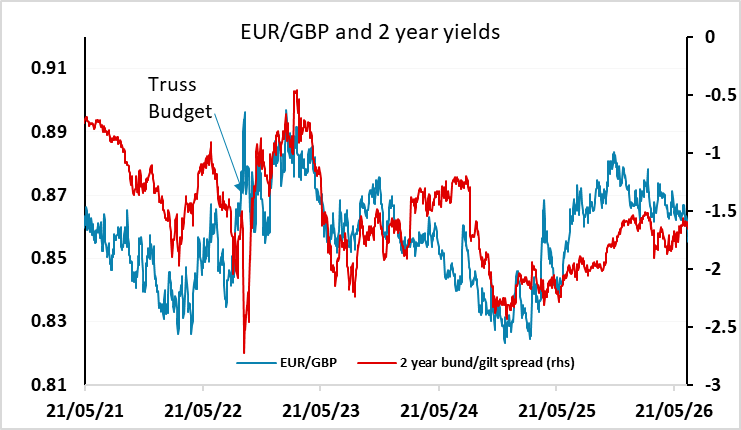
It's worth noting that while short-end DE-GB spreads have been rising they have in fact only ‘converged’ with EUR/GBP spot by recent years’ standards. Long-end spreads are still substantially more in UK’s favour unless you view that as a structural shift. That provides some counterpoint to any ‘relatively dovish BoE sterling weakness on the cross' story. If sterling is to underperform it is more likely to be driven by a shift to more risk-off tone, that has so far been avoided outside of Asia regionals with some specific tech concentrated moves only elsewhere.
Europe also sees some key data out today. The flash Q2 GDP estimate is expected to show an overall gain of around 0.2% after a 0.2% fall in Q1. We also see some of the preliminary national CPI data including Spain and German state figures, with a pick up of around 0.2pp expected on the back of renewed energy price gains. Switzerland has the latest KOF readings.
Focus will also be turning to Friday’s BoJ, not because a move is expected (zero probability of a hike priced in), but because it isn’t. Given that baseline, the meeting can only really surprise on the hawkish side. Relative Nikkei performance this months should also, in theory, be slightly yen supportive on adjustments, although it will tend to be overridden by broader dollar tone out of the Fed and impact can be hit and miss.
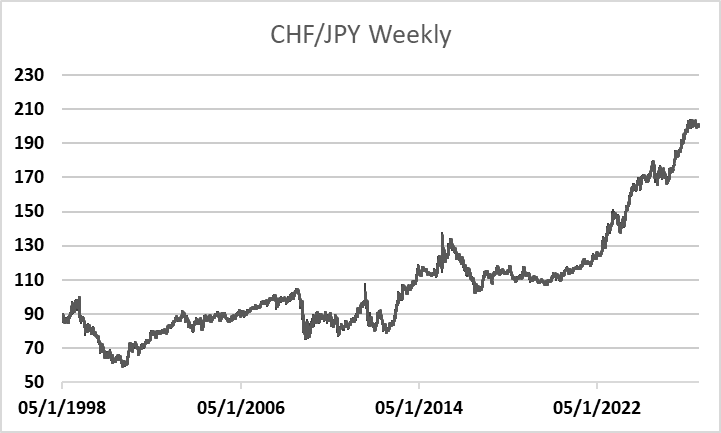
Stepping back a little, one interesting side story we have been mulling in recent weeks has been CHF/JPY. This cross is now in a very slow roll over after an astronomic rise. It comes against a backdrop of extreme yen weakness and until recently, extended relative nominal CHF strength. And a similarly polarised central bank story of a SNB until recently complaining about this strength (even idly noting it’s notional ability to intervene) while the BoJ is focused on normalisation and halting weakness. This week has also seen press reports suggesting the SNB anticipated rates remaining at zero into 2027, drawing no comment. Carry, forwards and longer spreads are thus all now modestly against the CHF, as the cheapest carry, with also some possible nonlinearity around the attraction of zero rates funding. So that at least asks the question – do you want to run massive yen carries, against the direction of policy, at extreme yen weakness, at a time when risk could spike? Or would you switch carry to rich CHF, with the direction, if you were so determined, or otherwise exit and hedge your other risk positioning with short CHF/JPY. It’s an interesting question at least… Post fact, clearly the yen has been the 2020s carry of choice, but a prior now, what’s the risk going forward. Both leaving long-running heavily in the money JPY positions running rather than closing, or booking and switching if you still believe in running a version. We might discuss this talking point in more detail elsewhere.
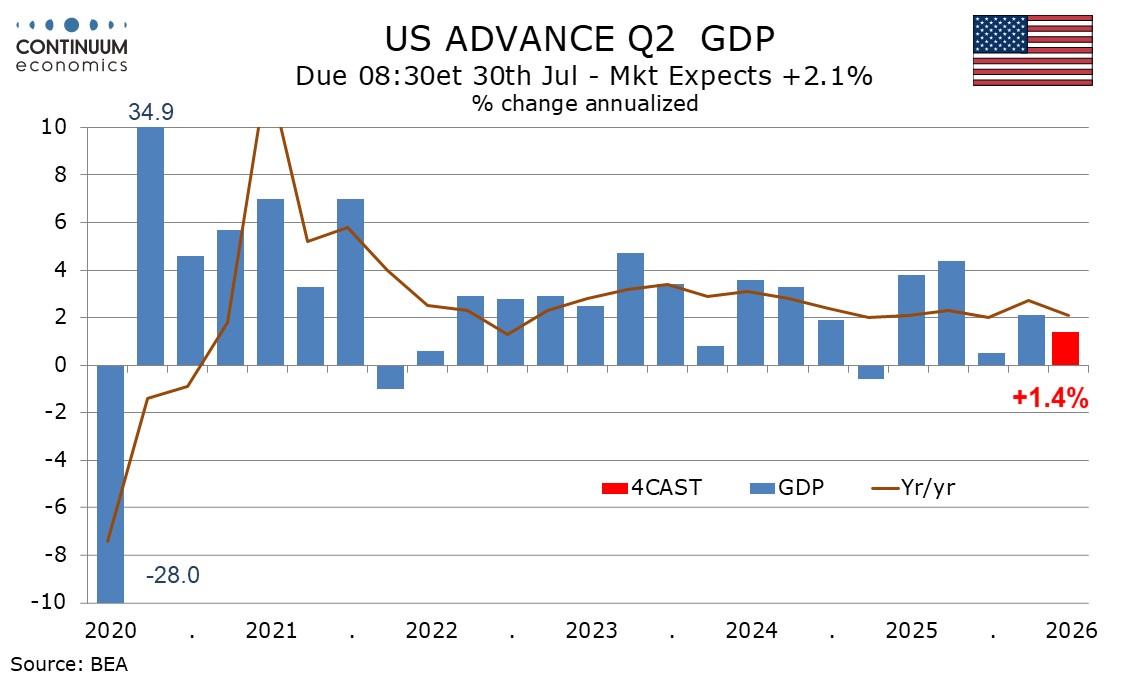
Later, the US also sees the Q2 GDP release, which we expect to rise by 1.4% annualized, restrained by weakness in inventories and net exports. We expect core PCE prices to rise by 3.2%. This assumes a 0.1% rise in June’s core PCE price index which will be released at the same time. We expect gains of 0.3% in both personal income and personal spending for June. Weekly initial claims are also due.