Bank of Canada - A cautious tightening cycle starts
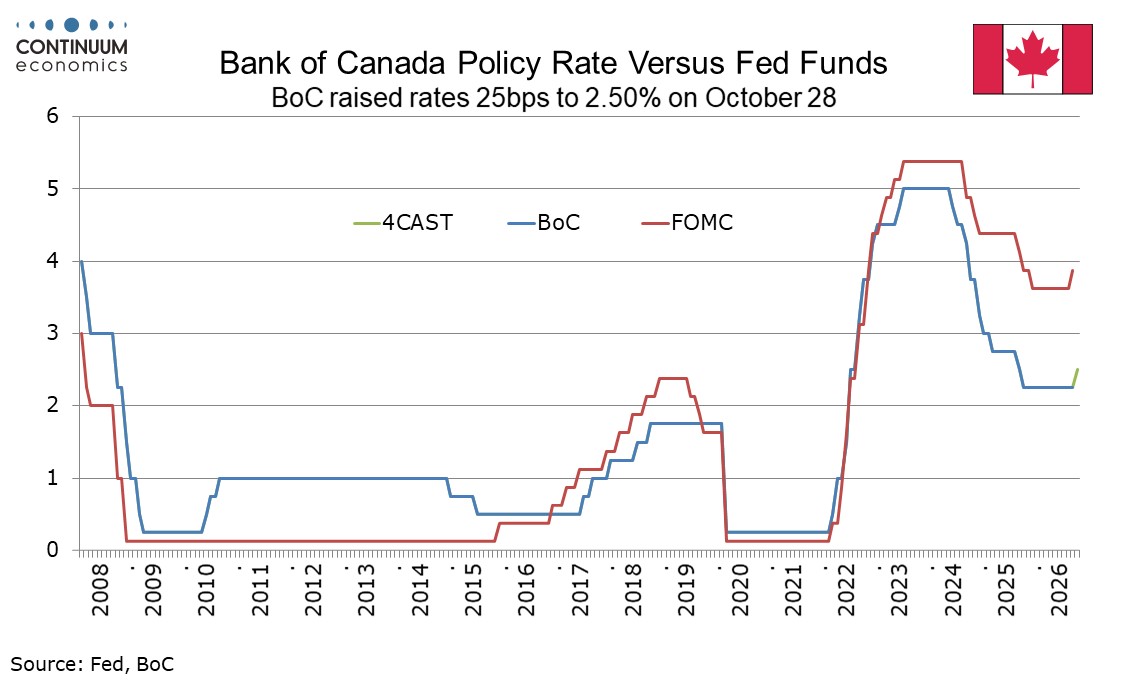
The Bank of Canada’s decision to tighten by 25bps to 2.50% was as expected by the markets with the risks of elevated oil prices the principal reason behind the move. Uncertainty means the BoC will be cautious going forward, but further rate hikes look likely, if not at consecutive meetings. We now expect moves in Q1, Q2 and Q3 of 2025, which should be enough to prevent a sustained bounce in core CPI.
Bank of Canada Governor Macklem saw two important developments since the July Monetary Policy Report. Firstly the outlook for inflation had deteriorated with oil prices expected to remain higher for longer, and secondly the growth outlook has improved modestly despite fresh US tariffs. These tariffs are expected to give Q4 GDP a hit but growth is expected to regain momentum in 2027.
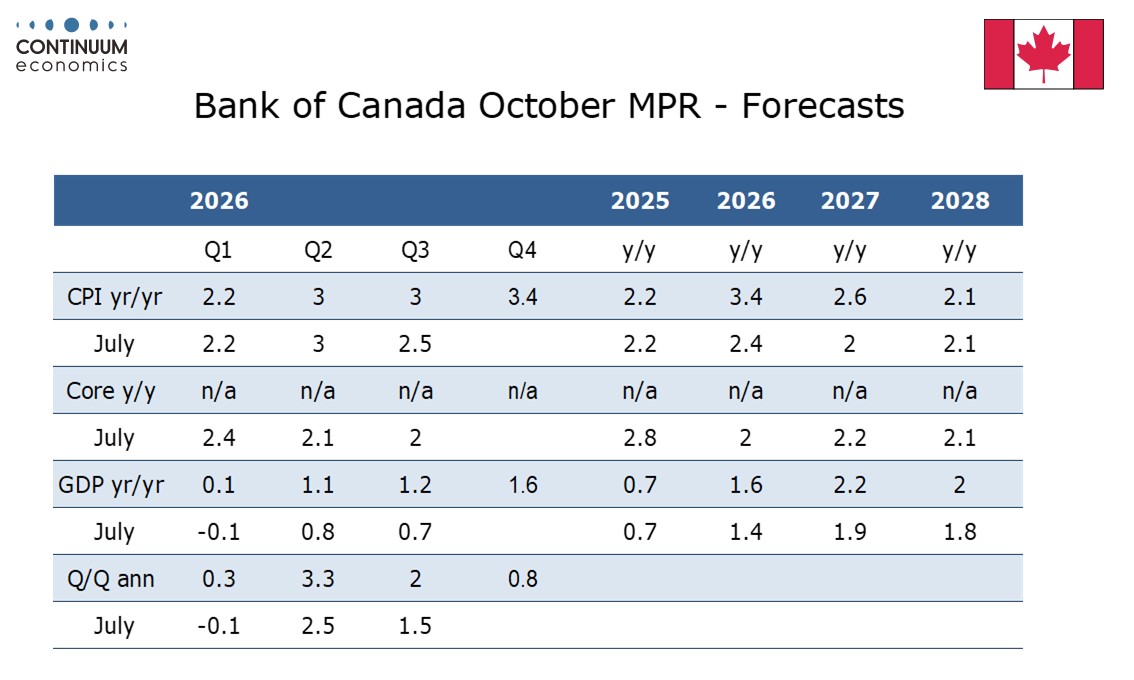
In the latest Monetary Policy Report, GDP forecasts have received a modest upgrade, with 2026, 2027 and 2028 forecasts all lifted by 0.2%-0.3%. Inflation forecasts have been revised sharply higher, 2026 to 3.4% from 2.4% Q4/Q4, 2027 to 2.6% from 2.1% Q4/Q4, though 2028 is left unrevised at 2.1% Q4/Q4. It is notable that the BoC has not provided forecasts for core inflation in this report, suggesting uncertainty on to what extent energy prices will feed through to the core. The message is that the BoC will do what it takes to keep core CPI, currently near the 2.0% target, contained.
The BoC debated two options, hold or hike. The former case noted limited pass-through of energy costs so far and continued excess supply, while the main argument for a hike was that energy prices were higher and that cost pressures were building. The statement noted Bank surveys suggested cost pass-through will increase next year and that short-term inflation expectations have risen.
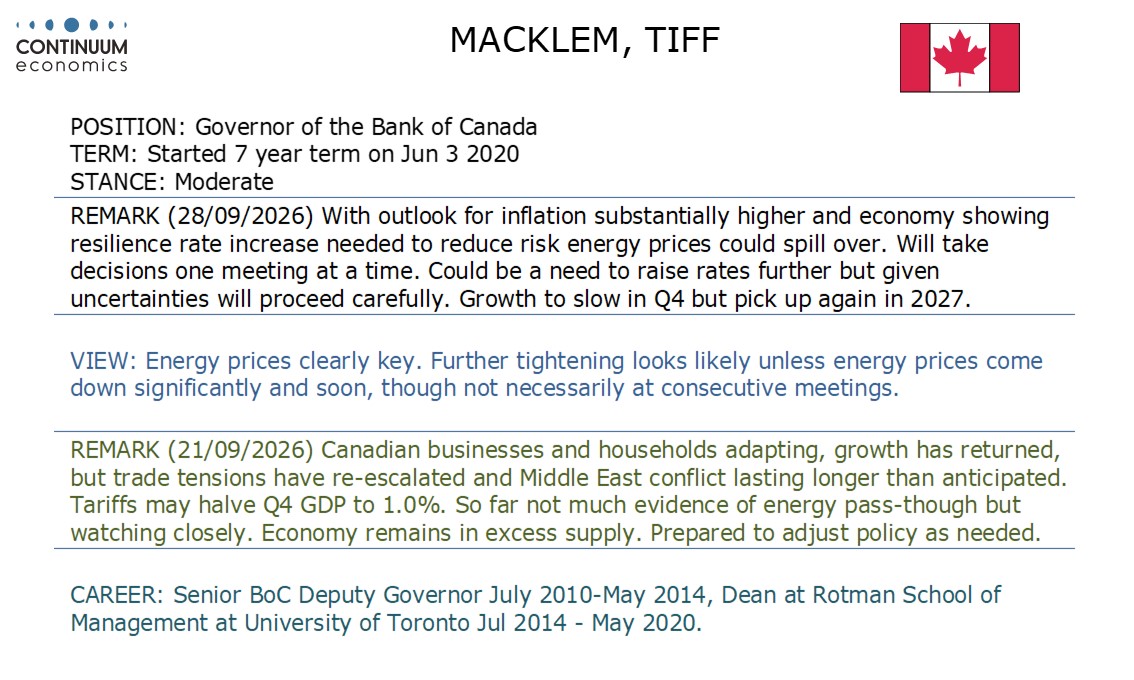
Macklem stated that there could be a need to raise the policy rate further, but given the uncertainties the BoC will proceed carefully. That suggests tightening is more likely at meetings that include a Monetary Policy Report, for which the next is due in January. We look for moves than, after a December pause, then in April and July. We expect that pass-through from oil to core inflation to oil will be quite modest and we are not convinced that a fourth rate hike in July will be necessary. However, our GDP forecasts suggest that a revival in momentum will be peaking about that time, and that leads us to predict rates moving to a peak of 3.25% in this cycle. That would see rates moved to the top of the 2.25-3.25% range that the BoC sees as neutral. Rates moved off the bottom of that range today.