FX Weekly Strategy: Asia, Jul 27-31
FOMC Unchanged policy with an unspoken tightening bias
U.S. Q2 GDP and PCE
BOE Hawkish Noises
Canada Heading for a healthy Q2 GDP
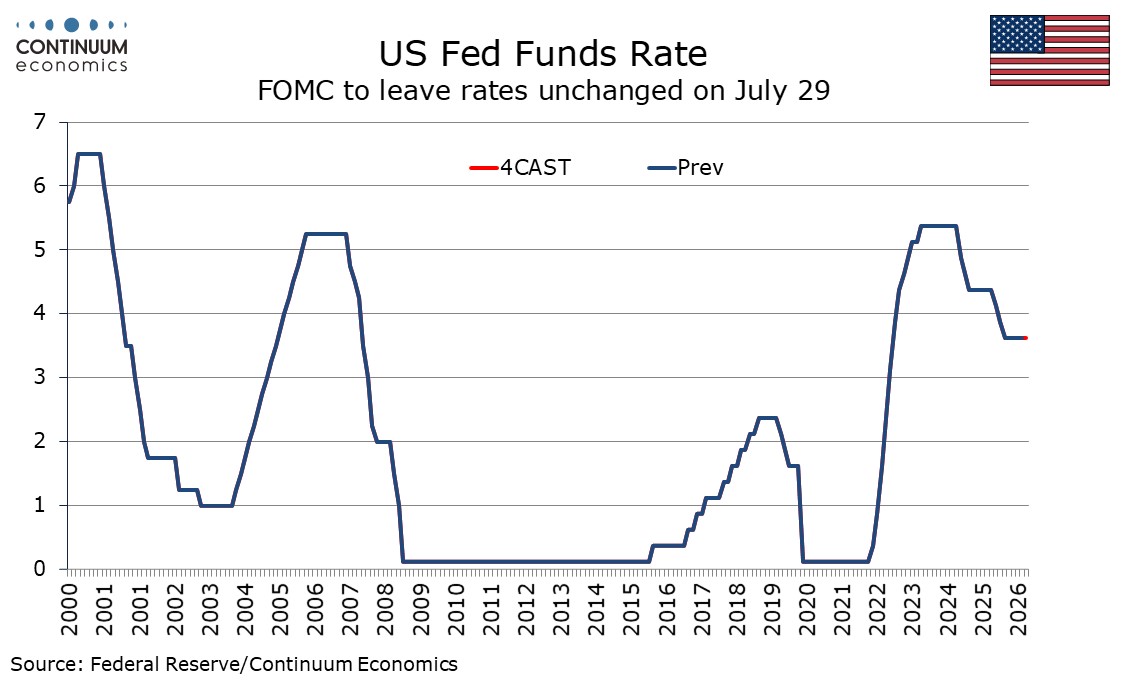
The FOMC meets on July 29 in a meeting that will see no update to the dots or economic forecasts. With forward guidance now becoming limited all meetings should be seen as live, but after softer than expected June non-farm payroll and more importantly CPI data, a change in policy looks unlikely at this meeting. The case for tightening will be debated, but no more than two hawkish dissents are likely.
The last meeting on June 17, the first under incoming Chair Kevin Warsh, saw rates left unchanged at 3.5-3.75% with no dissenting votes, but the dots had a hawkish skew, with nine out of eighteen respondents seeing tightening this year, and only one seeing an ease and eight seeing steady policy. Minutes from the meeting showed two scenarios were discussed. The first saw inflationary pressures dissipating and inflation soon beginning to return to 2%, in which it would be appropriate to maintain or eventually lower the target range for rates. The second saw stable labor market conditions and persistent elevated inflation, under which some policy firming would be needed.
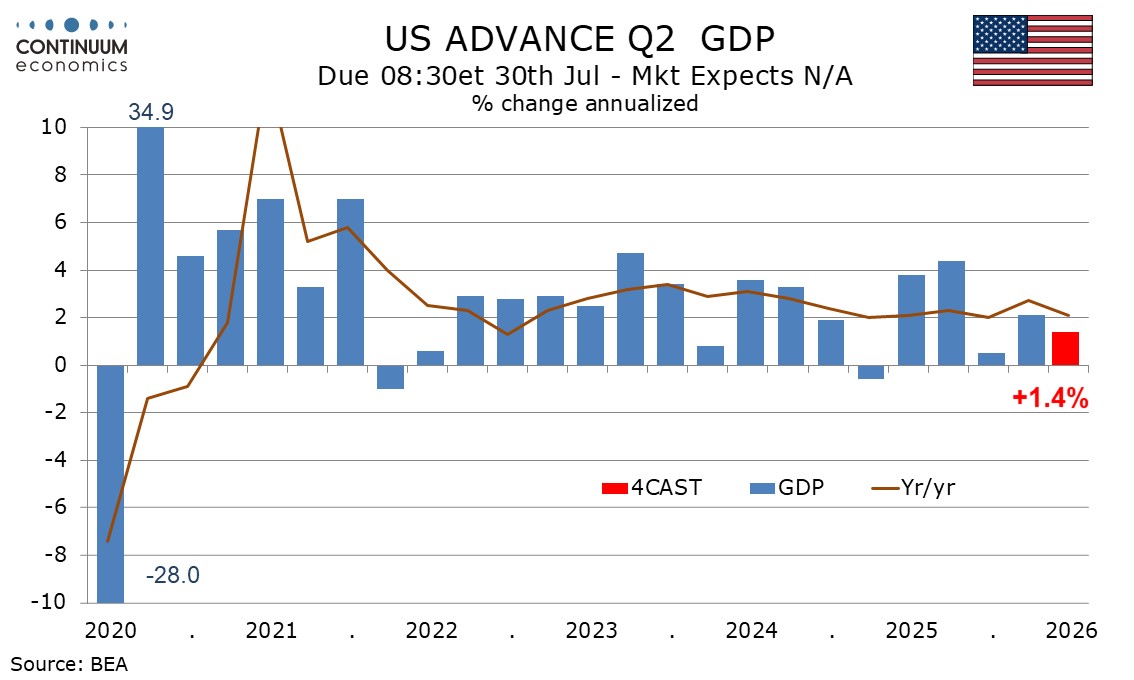
We expect a modest Q2 GDP increase of 1.4% annualized, though there is still uncertainty over June data for trade and inventories, which we expect to act as negatives in the quarter as a whole, while assuming some improvement in their June data. Domestic demand is likely to look strong in Q2, with a rise of 3.7% in final sales to domestic buyers (GDP less inventories and net exports), which would be the strongest increase since Q3 2024.
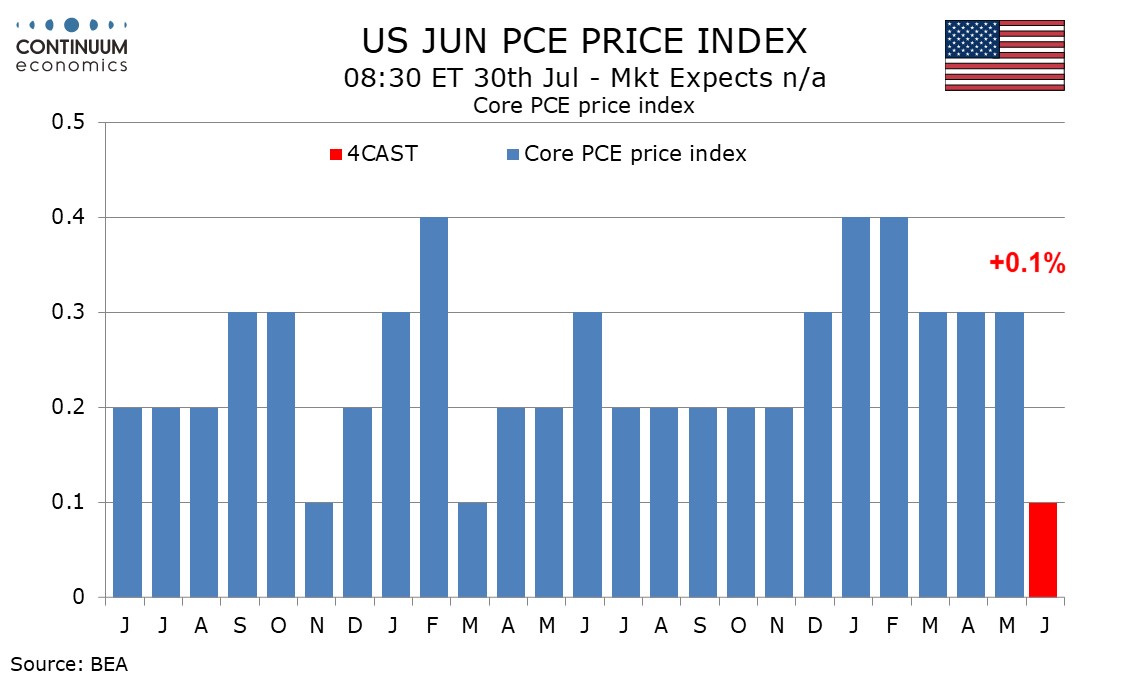
June’s personal income and spending report may be overshadowed by the Q2 GDP report released at the same time. We expect a subdued 0.1% increase in core PCE prices, with overall PCE prices down by 0.1%, leaving gains of 0.3% in both personal income and personal spending looking respectable in real terms. Core CPI prices were unchanged in June. We do not expect core PCE prices to be quite as soft as this, with core PCE prices having tended to outperform core CPI in the year to date. However a subdued PPI as well as the CPI suggests core PCE prices will be significantly slower than recent trend.
Figure: UK Core CPI Yr/Yr (%)
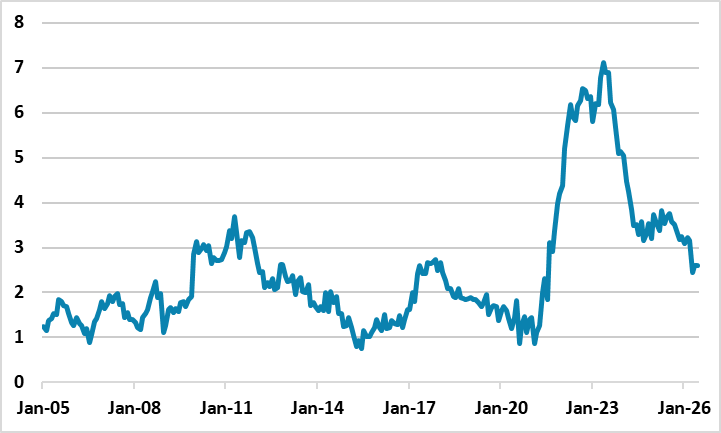
The BOE will likely maintain a hawkish bias on July 30, but are unlikely to signal a September hike. The June CPI did not really change this picture, with the core unchanged at 2.6%. Though BOE Bailey recently noted the unstable process (in the Straits of Hormuz and for energy prices), he also noted that economic data pointed to limited impact on UK inflation and this argues against signalling a September hike. We remain of the view that a soft economy will stop the BOE from hiking and that policy rates will be cut in 2027.
The latest CPI figures in the UK provide little surprise for the BOE. Headline came down as expected given the lower oil prices at the time compared to May, while food prices were also soft. However, core inflation at 2.6% Yr/Yr was unchanged compared to the May outcome. Nevertheless, Tuesday labour market data does suggest that underlying inflation pressures should ebb, with May average earnings ex-bonus at 3.4% and HMRC June payroll change at a soft -3k.
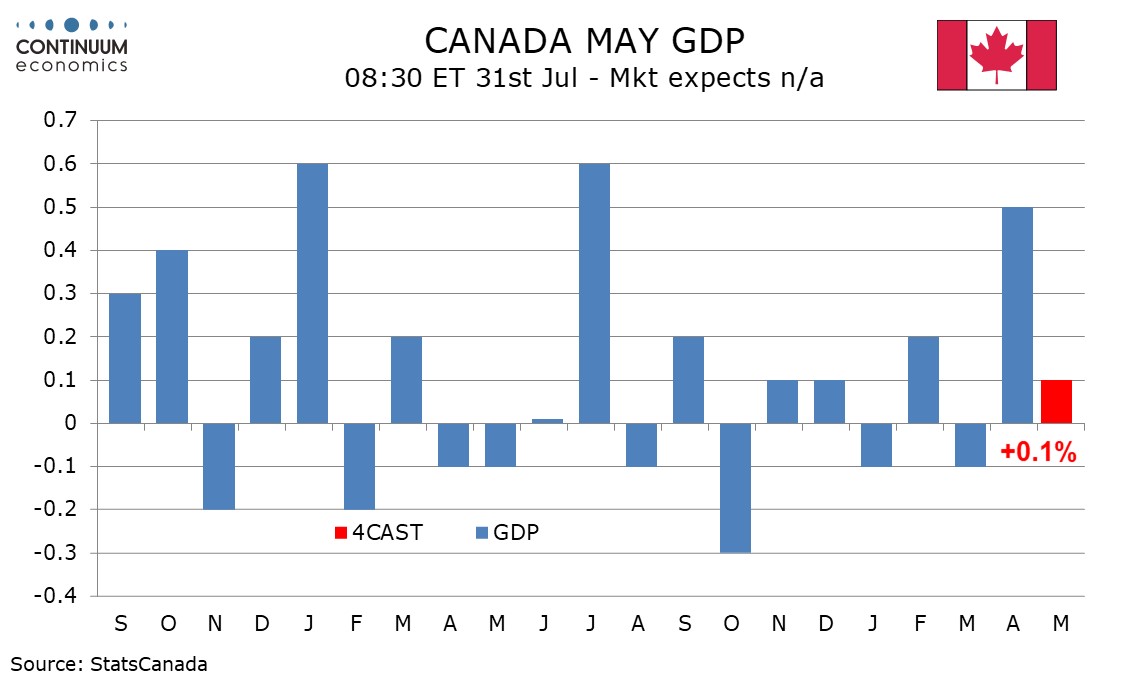
We expect May GDP to increase by 0.1%, in line with a preliminary estimate made with April’s report, which showed a strong 0.5% increase. We expect a 0.2% increase in services, in line with recent trend, supported by gains in finance/insurance and real estate/rental/leasing, as signaled with April’s report. We expect a 0.2% decline in goods in a correction from a 1.2% April bounce despite a likely modest increase in manufacturing.
For the Week Ahead
USA
The highlight of the US calendar is the FOMC meeting on Wednesday. After the subdued June CPI we expect policy to be left unchanged but there will be some debate on tightening, with possibly a couple of dissenting votes. The statement is unlikely to give much away and the dots will not be updated at this meeting. Warsh will avoid forward guidance but his tone may lean hawkish.
There is also plenty of data. On Monday we expect a 3.7% increase in June durable goods orders and a 0.9% increase ex transport. On Tuesday we expect the advance June trade deficit to correct to $100.8bn from May’s sharply higher $105.9bn. Advance June wholesale and retail inventories are also due. Tuesday also sees May house price data from FHFA and S and P Case-Shiller and July consumer confidence.
Durables, trade and inventories data may lead to some fine tuning for estimates for Thursday Q2 GDP release, which we currently expect to rise by 1.4% annualized, restrained by weakness in inventories and net exports. We expect core PCE prices to rise by 3.2%. This assumes a 0.1% rise in June’s core PCE price index which will be released at the same time. We expect gains of 0.3% in both personal income and personal spending for June. Weekly initial claims are also due. On Friday we expect a 0.7% rise in Q2’s Employment Cost Index. The final Michigan CSI is also due, and may be weaker than a stronger preliminary release given renewed Middle East concerns.
CANADA
Canada releases May CPI on Friday. We expect a 0.1% rise in line with a preliminary estimate made with a strong April report. The preliminary estimate for June will probably look similar to May, keeping Q2 on target for a 2.5% annualized forecast from the Bank of Canada.
EZ
The key figure will be the flash Q2 GDP estimate on July 30, though recent volatility in quarterly numbers means that markets will want to do a deeper analysis dive rather than reacting to the headline – a small rise is forecast after a 0.2% fall in Q1. July 31 also see the July flash CPI figure for the EZ, where the headline is projected to rise to 3.0% Yr/Yr – given the renewed oil prices increase with Iran/U.S. hostilities. Thursday also see the July economic sentiment indicator, while July 27 sees the June money supply figures.
UK
The key event is the July 30 MPC meeting. Though no change in policy rates is expected, the market is looking for clues on a September hike – with a heavy bias of a 25bps hike in the money market. The press conference and monetary policy report will likely be hawkish, but is unlikely to pre signal a September move. Elsewhere, June money supply figures are released on July 29.
JP
Tokyo CPI on Friday will continue to demonstrate how the headline figure being suppressed by stimulus while core-core inflation reflects the latest rebound in private consumption. Retail trade and unemployment rate is on the same day but will carry much less weight. The critical on paper BoJ meeting will likely be a non-event as BoJ assess the second round energy push inflation in the coming months. Copy and paste forward guidance is expected.
AU
All important CPI figure will be released on Wednesday. Q2 CPI should remain above target range and could see another jump towards mid 4% while monthly CPI could moderate for now. The trimmed mean CPI should gain more traction as RBA will be closely monitoring that figure. Governor Bullock will also be speaking on Tuesday and could preview what is to come.
NZ
Some tier two data on Thursday.
Recap of the Week
ECB 50% Probability for September Hike
UK Fiscal Policy and the New Chancellor
U.S. June A Subdued month for Industrial Production
Cautious trade for DXY
USD/JPY Consolidating for test of 164.00
Figure: Key euro area variables under the baseline and alternative scenarios (%)
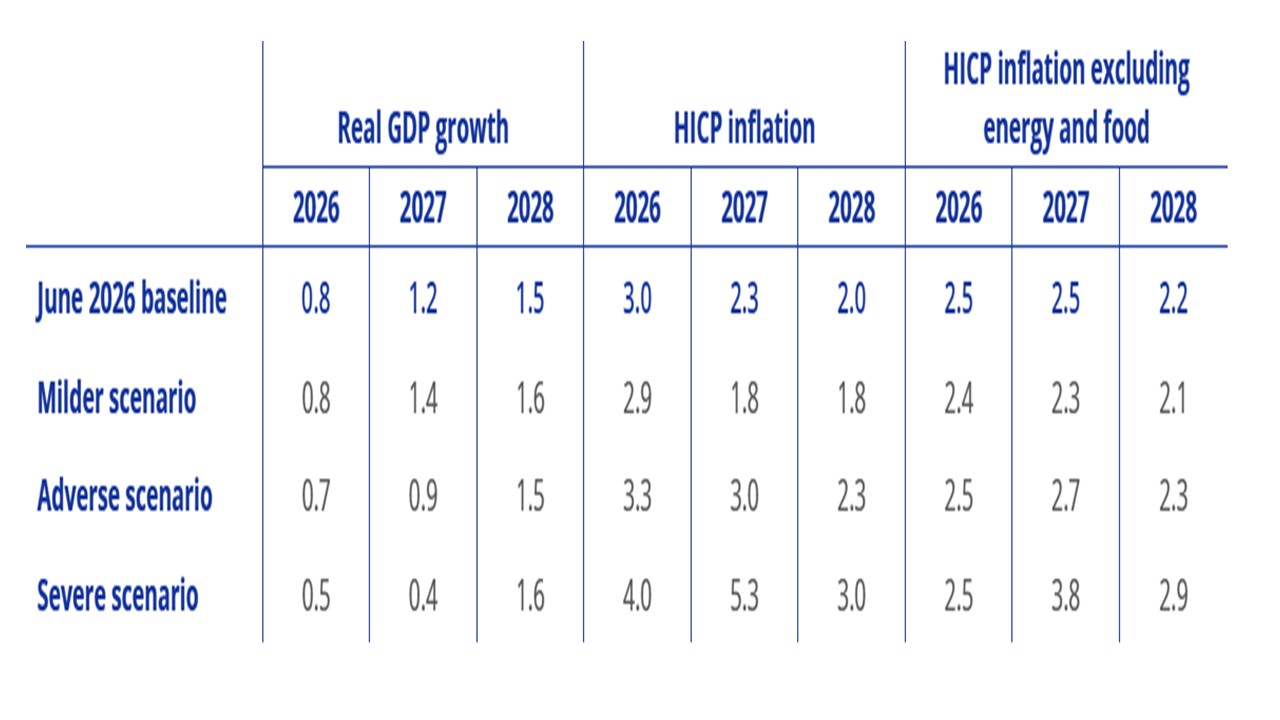
Lagarde disclosed that some ECB board members considered a hike at today’s meeting and she noted that the consensus was to wait for incoming data before the September 10 meeting and then reassess. This clearly signals that the September meeting will seriously consider a 25bps hike, but she was less hawkish elsewhere and highlighted that the Straits of Hormuz and energy prices are big swing factors. Given the wage inflation trajectory, little sign of 2nd round effects, tight financial conditions, plus Trump’s bias to lower gasoline prices (and a renewed ceasefire) we attach a 50% probability to a hike at the September meeting rather than the 70% discounted in the money market.
The ECB remained hawkish, despite some recent data including the June HICP inflation figure. The ECB statement felt more comfortable on Q2 GDP, but the interpretation of the labor market data is that a softening is currently underway. On inflation, Lagarde in the statement acknowledge that wage inflation and labour cost index are coming under control, which we feel that lagged effect of the economy slowing and also financial conditions being tighter than the level of the ECB depo rate. Even so, 1st round inflation effects are clear and will get worse in July with the renewed surge in energy prices.
Figure: 10yr Gilt v U.S. Treasuries and BOE-Fed Funds (%)
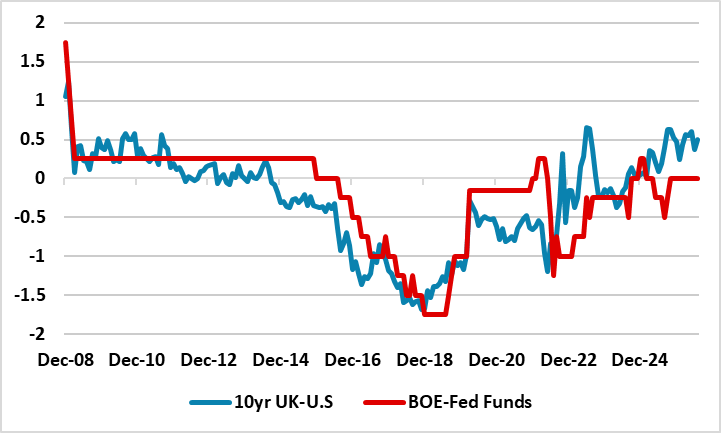
Apprehension exists over new UK PM Andy Burnham’s government fiscal policy. While Burnham has reiterated yesterday his commitment to the fiscal rules and also suggested a little tax rise to pay for cost of living breathing space, markets remain nervous that political pressure will see fiscal slippage. This morning’s scrapping of VAT on electricity (£850mln 2026/27) is funded by scrapping digital ID's, but shows the political pressure the government is under. Nevertheless, this is not acute and the 10yr UK-U.S. Treasury spread is only mildly elevated compared to the 2022 period when yields spiked much more than the BOE-Fed policy rate spread would suggest (Figure).
The appointment of John Healey is mixed. While being a credible cabinet minister and good communicator, he has championed higher defence spending and may not have the political strength to block fiscal slippage from other cabinet ministers.
Work will begin in earnest now for the autumn budget, with some reports that the Burnham government would also like to review spending targets at the same time. A honeymoon period does provide scope for the new government to differ compared to the Starmer administration, but this is restrained by UK politics and a more centre left administration under Burnham than under Starmer. Some of this can be seen in comparison to the IMF and OECD UK reviews that have just been finished. Both recommend reducing the overgenerous triple lock rule for state pension increases, but this is likely to be politically too difficult before an expected 2029 general election. The same holds true for a land value tax/reform of property taxation and significant reform of disability benefits. These measures are important for the 2030’s and 2040’s when the UK fiscal trajectory deteriorates due to population aging and associated health/pension and disability spending increase.
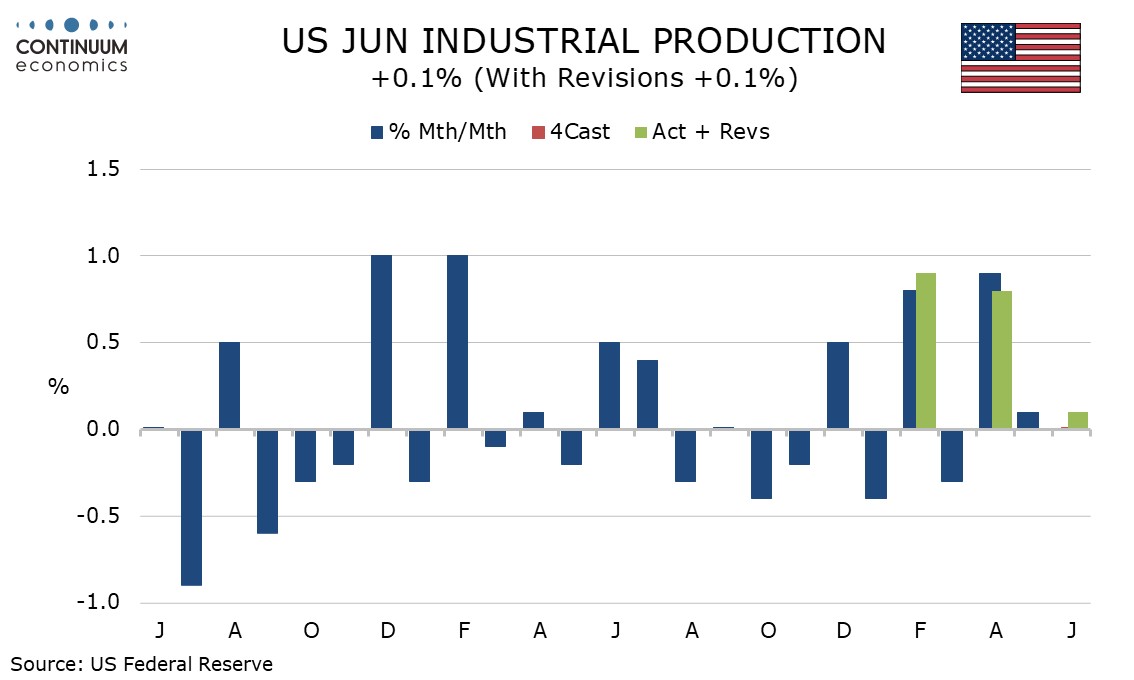
June industrial production has seen a second straight subdued month to follow a strong April, still leaving a healthy underlying picture but may temper some excessive optimism over the impact of rising AI-led investment. Industrial production increased by 0.1% on the month with mining and utilities both up by a moderate 0.4%, but manufacturing output was unchanged after rising by 0.1% in May and 0.7% in April.
Excluding gains in autos, manufacturing output fell by 0.1% after a flat May and a rise of 0.7% in April. Business equipment actually fell by 0.4% in June but after gains of 0.9% in May and 1.7% in April still looks strong in Q2.
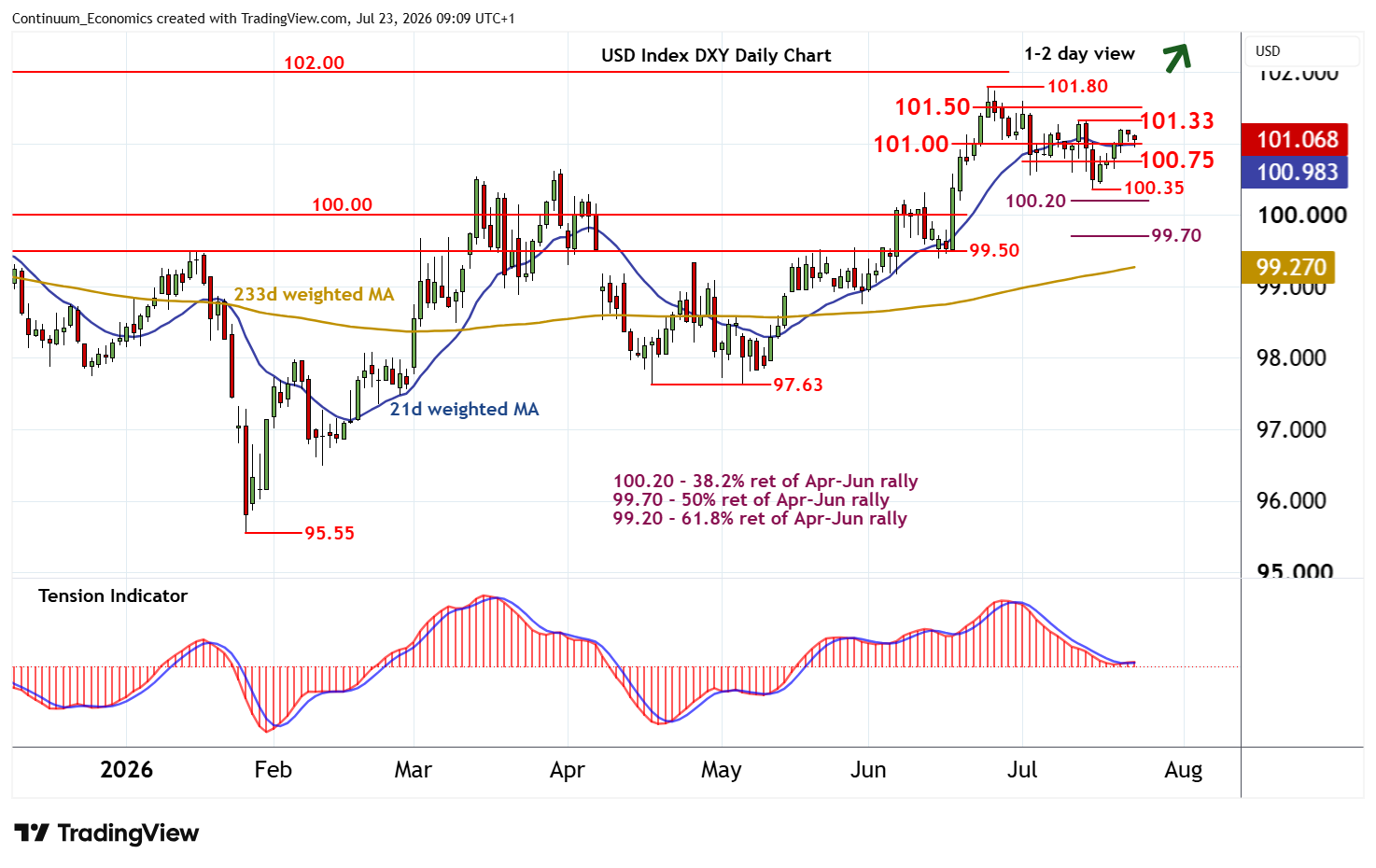
Cautious trade has given way to a test of support at 101.00, where fresh buying interest is prompting fresh consolidation. Intraday studies are under pressure, highlighting room for a retest beneath here. But rising daily readings should limit any break in renewed buying interest/consolidation above 100.75. In the coming sessions, cautious trade is expected to give way to fresh tests higher, with focus to turn to the 101.33 weekly high of 13 July. But mixed/negative weekly charts should limit any immediate extension beyond here in consolidation within the 101.50 - 101.80 strong barrier. Meanwhile, a close below 100.75 would add weight to sentiment and open up a deeper retracement towards the 100.35 weekly low of 15 July.
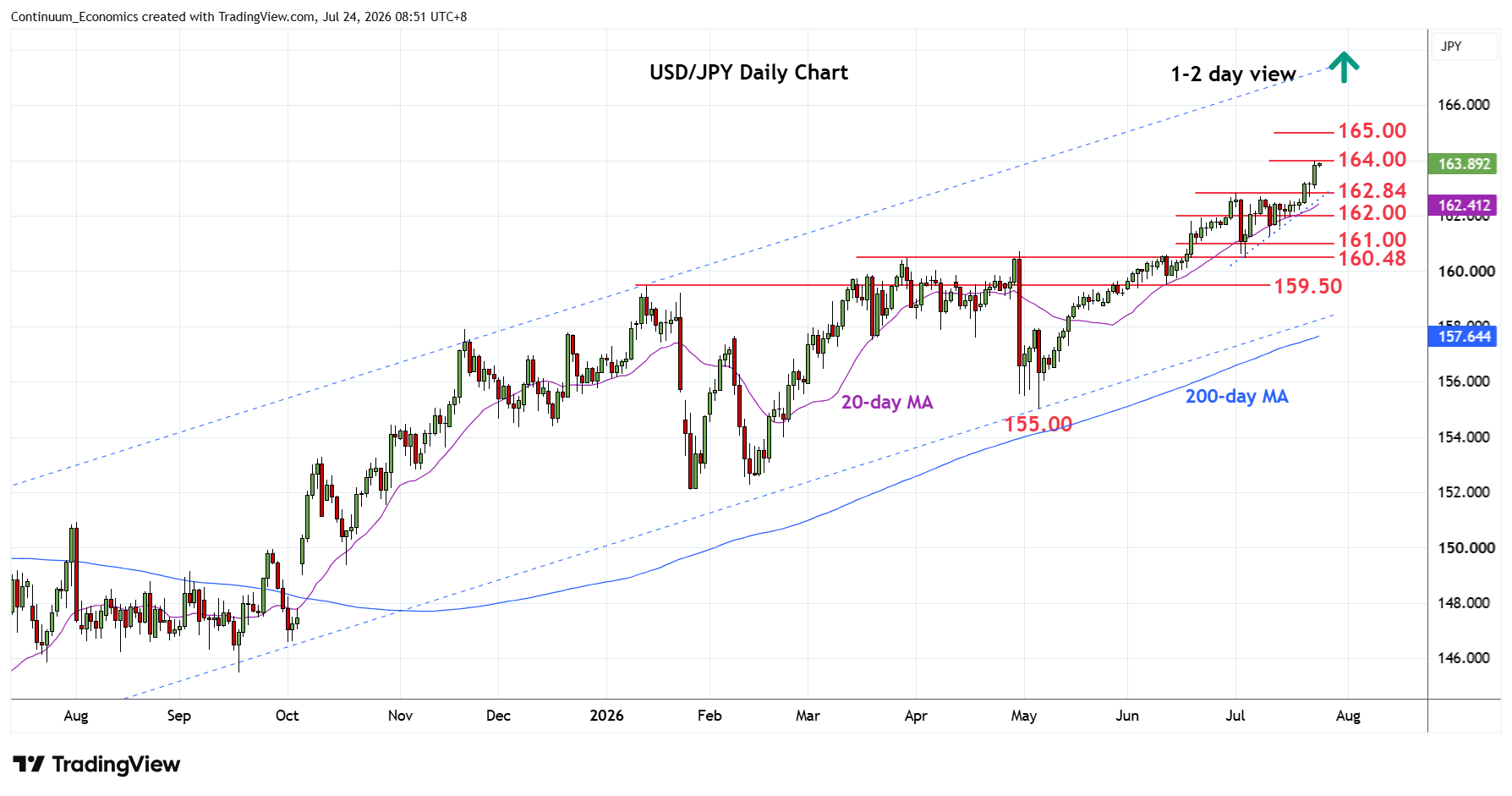
Break above the 163.24 Tuesday's high has seen extension to fresh multi-year high to tag the 164.00 level. Bullish gains from the April low keep pressure firmly on the upside and suggest scope for break higher. Beyond this, will see scope to retest 164.55/164.95 highs of November 1986 and the 195.00 figure. Meanwhile, support is raised to the 163.24 and 162.84 recent highs which should now underpin. Would take break of these to ease the upside pressure and see room for consolidation to support at 162.00 and 161.28/00 area.