CHF/JPY and the carry question
· CHF/JPY has become interesting from several directions: extreme relative valuation, changing carry rankings, opposing official preferences over currency direction, and the beginnings of a possible technical rollover. When things align, they can encourage some migration in positioning and funding behaviour.
· Established yen carry increasingly embeds substantial risk, both internally, through valuation and changing Japanese policy, and externally, through the possibility of a wider volatility event.
· For investors determined to run carry, the CHF might become the increasingly interesting alternative funding currency. For those growing more circumspect, short CHF/JPY may instead offer some useful qualities as a running portfolio risk hedge (less costly and directional than USD/JPY).
CHF/JPY has risen enormously over the past decade, and especially since 2020. It is now showing the beginnings of a slow rollover, although there is nothing in the charts yet to suggest any more than that.
The cross also sits at the intersection of two valuation extremes. The yen is exceptionally weak on all basis, whether viewed outright or relative to its trailing trends, while the Swiss franc remains relatively rich despite its recent decline. REER and bilateral PPP measures show broadly the same divergence.
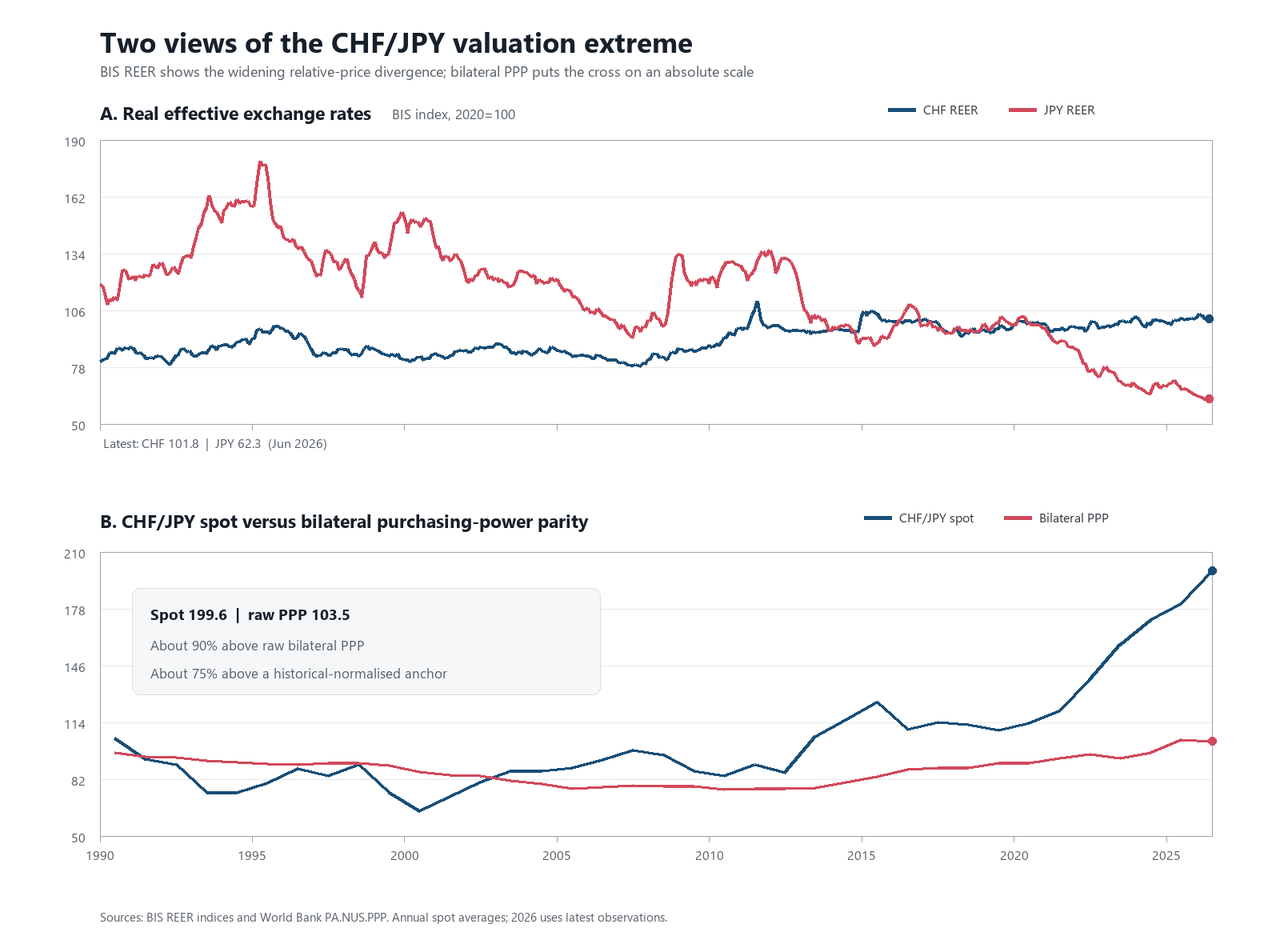
The policy asymmetry reinforces this. The SNB has this year voiced concern about excessive nominal franc strength and reiterated (albeit superficially and not seriously) its hypothetical ability to intervene. Recent media reporting also claim the SNB expects to remain at zero rates through 2027, although the SNB declined to comment. That marks CHF as a potential major outlier in terms of trajectory but also in terms of the last of the 'ZIRPs’ (zero interest rate policy) that can matter psychologically to funding appeal too
The BoJ is moving gradually in the other direction. Japanese rates are rising and bond holdings are being rolled down aggressively. Short-rate and longer-dated differentials are therefore beginning to move against the franc (if largely insignificantly for monthly carry). And the MoF in contrast are clearly considering all options, from recent heavy intervention, through to reviewing GPIF asset allocations for instance, to stem weakness. The BoJ is under pressure to accelerate rate normalisation (if simultaneously squeezed on this by the government).
The yen has plainly been the superior funding currency historically. That’s just given and embodied in the enormous rise in CHF/JPY. The question is whether the combination of extreme valuation, changing relative rates and opposing policy pressures has now shifted the prospective balance of risk.
So the question is twofold. For determined carry traders, does the CHF increasingly become ‘the new yen carry’ candidate, at least for the short-term? Short CHF now offers roughly one percentage point of relative carry advantage, with the prospective gap likely to widen. It also begins from a dramatically different valuation of the funding currency, although that valuation difference naturally reflects underlying fundamental and institutional differences as well.
For investors increasingly wary of accumulated risk across both currency and broader asset markets, does short CHF/JPY offer a relatively cheap running hedge? The position currently earns modest positive carry, is not purely directional like short USD/JPY, and so might have more optionality characteristics, at least on the strong proviso that the cross remains at worse stable.
Historically, CHF/JPY generally fell during severe volatility episodes before 2020. That relationship has not been so reliable since then, but would likely reassert in a more major event now given positioning.
The observation is ultimately a simple one. CHF/JPY is historically elevated. The yen is exceptionally cheap relative to the franc. The CHF now has the lower policy rate, and the gap is likely to widen. The SNB and Japanese authorities prefer different directions for their currencies. Weighing CHF vs JPY has become an 'interesting question’ then, whether you are running or hedging risk.