2026 Q2 Country Insights Scores to Download in Excel
The Country Insights (CI) Model is a comprehensive quantitative tool for assessing country and sovereign risk, measuring a country’s exposure to external and domestic financial shocks and its capacity to grow. Our full range of scores across 174 countries for the second quarter of 2026 is now available; the dataset allows comparison across periods and ranks all countries on the headline indicators, with each metric provided as an accessible time series.
The scores file allows for comparison with other periods and ranking for all countries across the headline indicators and are available as easily accessible time series.
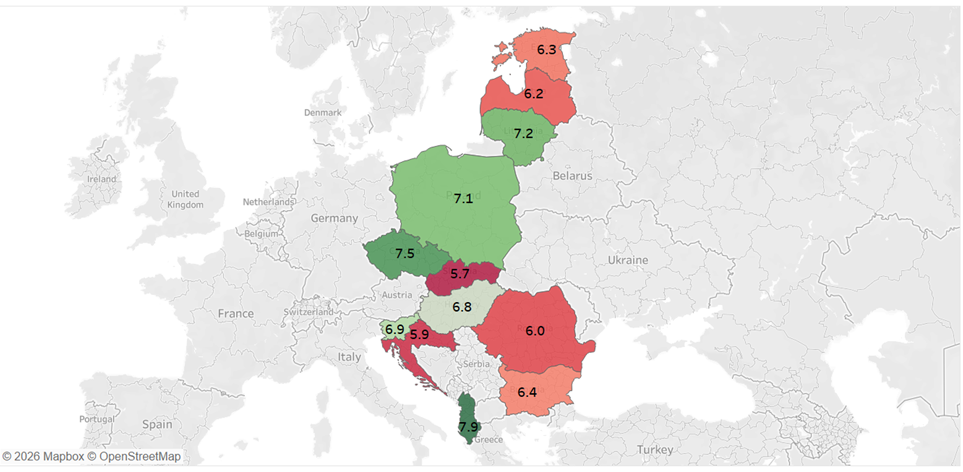
The Country Insights model generates three composite indexes: Investment Attractiveness (IAI), Sovereign Risk (SRI), and the Country Strength (CSI). The SRI is based on two underlying pillars, namely external adjustment capacity and institutional strength. Together, these dimensions capture a country’s macroeconomic fundamentals and socio-political resilience. Figure 1 illustrates the SRI ranking for selected CEE economies, where a score of 10 represents the strongest performance and 0 the weakest.
Figure 1. Sovereign Risk Index for Selected CEE Economies
Source: Continuum Economics
The SRI (Figure 1) points to a region that is far more homogeneous than most emerging market blocs. Every economy covered sits between roughly 5.7 and 7.9, with a regional median of 6.6, so there is no CEE sovereign in acute distress and none that reaches the resilience of the strongest global performers. The leading group comprises Albania, the Czech Republic, Lithuania and Poland, all scoring above 7.1 and indicating comparatively low distress risk. A wide middle tier follows, made up of Slovenia, Hungary, Bulgaria, Estonia and Latvia, clustered in a narrow band between 6.1 and 6.9 where differences are marginal rather than structural. Romania and Slovakia sit at the lower end, in a range of roughly 5.7 to 6.0, indicating greater exposure to financial shocks than regional peers but nothing approaching the fragility seen elsewhere. Albania's position at the top warrants some qualification, since it rests on very strong external metrics rather than broad institutional quality, and the country records the region's weakest scores for political institutions and domestic political risk.
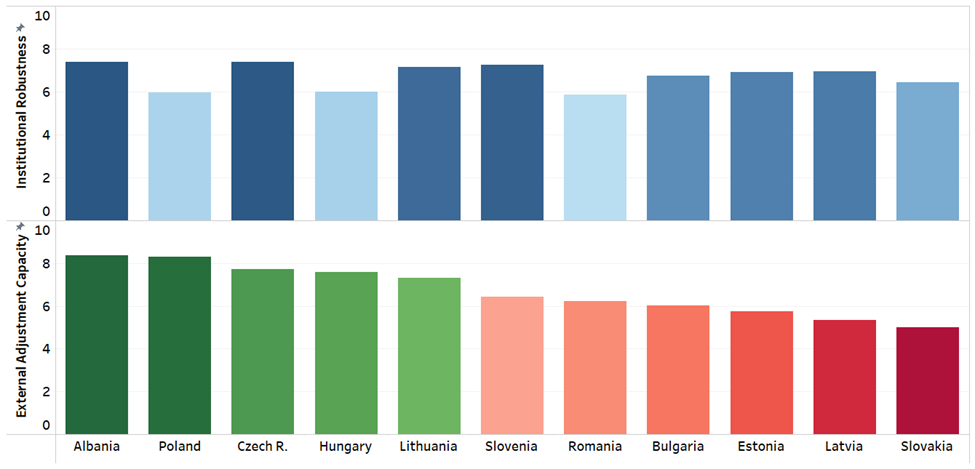
Decomposing the SRI into its two pillars shows that the region divides along a clear line (Figure 2). The two pillars are almost entirely uncorrelated across CEE, so a country's overall position depends largely on which of the two it leans on. Economies retaining their own currency score considerably better on external adjustment capacity, averaging around 7.4 and supported by reserve buffers and lower external indebtedness. Poland and Hungary are the clearest examples, pairing external scores of 8.30 and 7.59 with institutional scores of only 5.98 and 6.02. The pattern reverses among euro area members, where Slovakia and Latvia record external scores between 5.0 and 5.3 alongside firmer institutional readings of 6.4 to 7.0, reflecting the absence of independent reserves and exchange rate adjustment but the benefit of a shared policy framework.
Figure 2. SRI Pillars for Selected CEE Economies
Source: Continuum Economics
Within the institutional pillar, monetary policy is uniformly weak across the region, with a median of 2.66 and ten of the twelve economies scoring between 1.9 and 3.0, a legacy of the inflation surge of 2022 and 2023 when CEE recorded some of the highest rates in the European Union. Fiscal policy is what actually separates the region, ranging from 3.37 in Hungary, 3.76 in Poland and 4.04 in Romania at the weak end to above 8.0 in the Czech Republic, Albania and Lithuania. Romania stands out as the most stretched profile overall, combining the region's lowest monetary policy and current account scores with a weak fiscal reading. Taken together, the pillar analysis suggests that CEE's external buffers remain reasonably solid, and that fiscal credibility rather than external liquidity is the binding constraint on sovereign strength across much of the region.
See Article Resources (below) to access the full range of scores.