This week's five highlights
FOMC leaves rates unchanged with three hawkish dissents
U.S. Q2 GDP strong outside net exports, inventories and government
BoJ As Expected
USD/JPY Intervened
BOE Split Does Not Mean September Hike
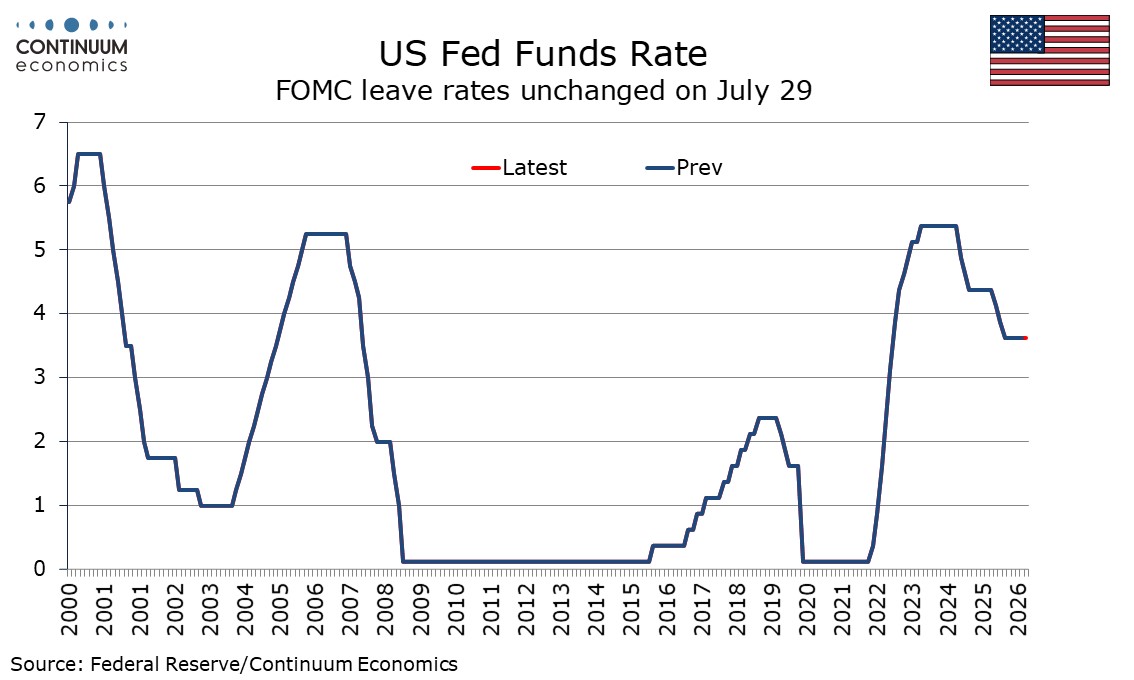
The FOMC has left rates unchanged as we expected, in a 9-3 vote, with three hawkish dissents for a 25bps tightening, from Cleveland Fed’s Hammack, Dallas Fed’s Logan and Minneapolis Fed’s Kashkari. We had expected only the first two of the three dissents, but Kashkari’s is not a major shock. Apart from three rather than zero dissenters, the statement was little changed from June’s, suggesting the economy is still seen as in a similar position, though continuing rather than reaffirming a policy of maintaining ample reserves in the banking system may be a little less strong. Softer than expected June non-farm payroll and CPI data does not appear to have changed much. Tightening will surely continue to be debated at upcoming meetings, with decisions dependent on incoming data and global developments, particularly in the oil price. Risks of tightening are growing but it does not yet appear to be a done deal.
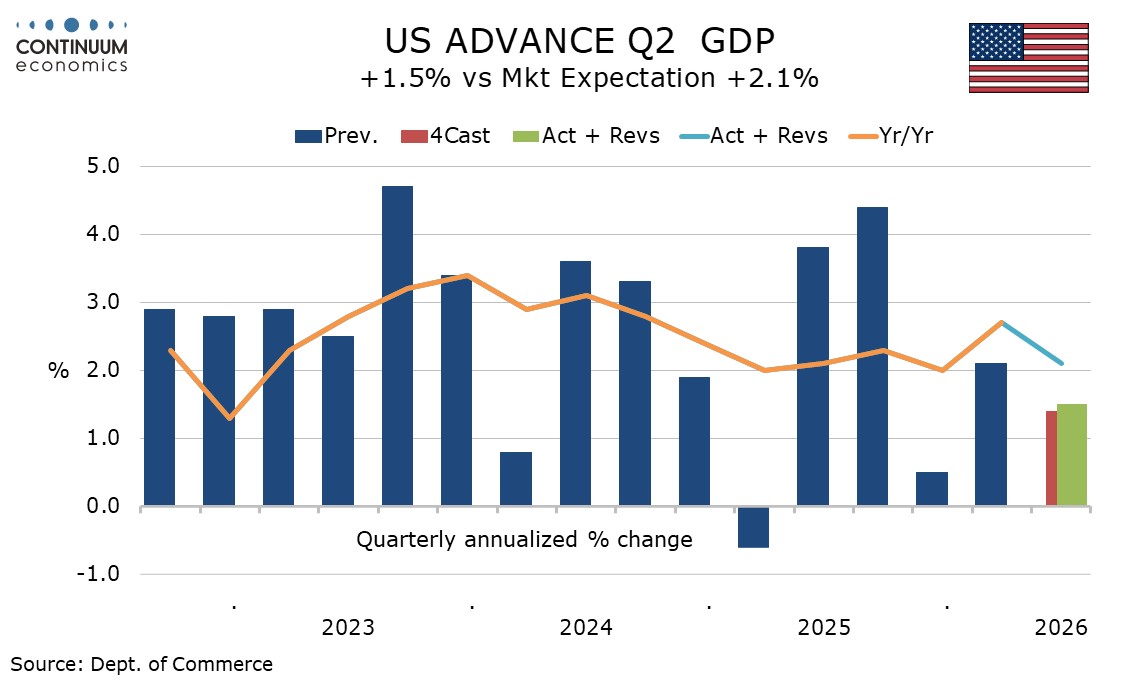
The advance estimate of Q2 GDP at 1.5% annualized is weaker than the market expected but in line with our 1.4% call. The detail is also broadly in line with our expectations, healthy excluding negatives from inventories and net exports, with final sales to domestic buyers (GDP ex inventories and net exports) up by 3.1%, the strongest since Q3 2024. Consumer spending with a 3.2% increase exceeded our expectations. Monthly data shows a 0.3% rise in June as expected but April and may were revised higher. Still, in real terms June saw a 0.4% increase in consumer spending, matching the upwardly revised May.
The Bank of Japan kept rate unchanged at 1% during its July 31 meeting as per forecast. Following the 25-basis-point hike in June, this pause was approved by an 8-1 vote. Board member Hajime Takata was the only dissenter, advocating for a preemptive 25bps hike to 1.25% to address upside inflation risks. This pause provides breathing room as policymakers reassess geopolitical developments in the Middle East, which the BoJ explicitly cited as an upside risk to demand-driven price pressures.
Forward guidance remained hawkish, maintaining a cautious, data-dependent tightening bias. The BoJ reiterated its willingness to raise rates further if inflation risks continue to increase. The fact that there was only one dissenter suggests a September hike is likely off the table, as previous BoJ tightening episodes have generally been preceded by meetings with multiple dissenters. This leaves market anticipation firmly favoring a move in October. An October meeting aligns with the expiration of energy subsidies, clearer visibility on how Middle East conflicts settle, fresh Q3 real wage data, and the release of the updated Quarterly Outlook Report. This gives the BoJ a clean, data-backed runway to resume hiking rates.
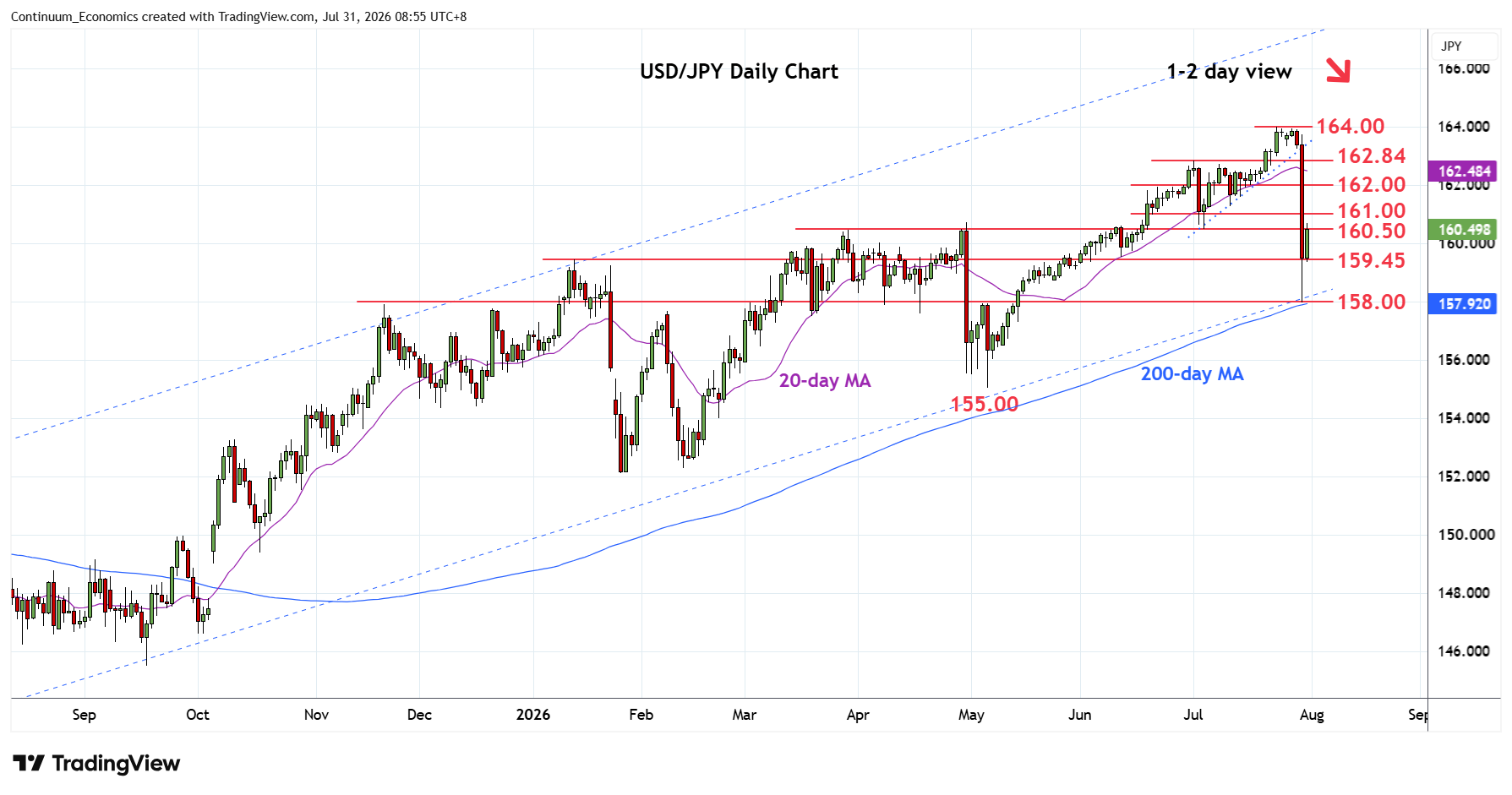
While on the chart, break of support at the 163.24/162.84 area saw sharp plunge to reach the April channel and 200-day MA at the 158.00 level. Prices has since turned up to consolidate above the 159.45 support with bounce reaching resistance at 160.50. Higher still, if seen, will see scope to resistance at the 161.00/28 area and possibly 162.00. Consolidation is expected to give way to renewed selling pressure later with support now raised to the 159.45/159.00 area ahead of 157.95 low. The key trigger is suspected intervention from the Japan side, a classic five figure drop, from historic high.
Figure: CPI projections from BOE (%)
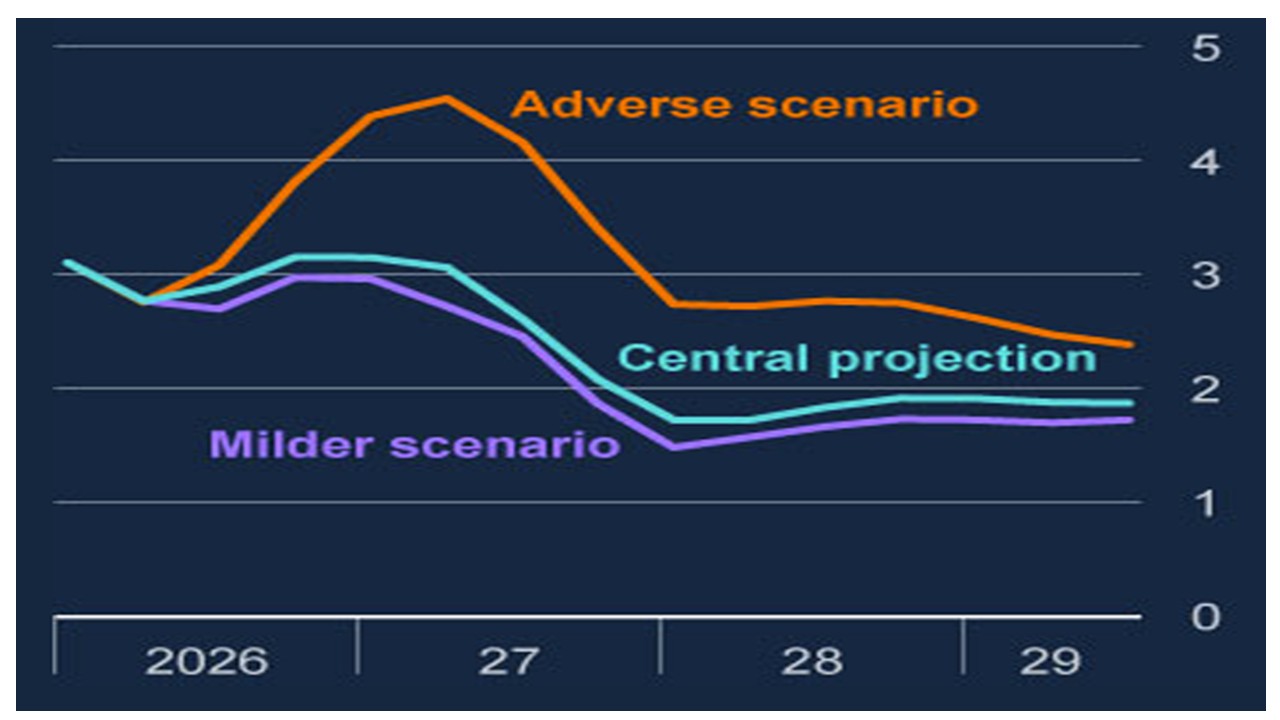
Overall, the July MPC minutes and monetary policy report/press conference suggest that the MPC is not convinced of a September hike and a worsening of energy price rises and/or 2nd round effects would be required to shift the voting to a 25bps hike. While the MPC has a hawkish bias the press conference, the stronger argument is that tight financial conditions and an output gap guard against upside inflation risks. This sounds like a hawkish bias, but no guarantee of a 25bps hike at the September meeting and we forecast no hike. A moderately high risk will remain of a rate hike into Q4 2026, but on balance we forecast unchanged policy rates throughout 2026.